DKNet
DKNet.AspCore.Idempotency
Idempotency support for ASP.NET Core minimal API endpoints. The package wraps an IEndpointFilter that recognizes a
client-supplied idempotency key, blocks the same operation from running twice, and replays (or rejects) the retry —
protecting POST/PUT/PATCH handlers from network retries, double-clicks, and at-least-once message redelivery.
✨ Why use it?
- Safe retries – A client (or a retrying HTTP client, or a message consumer with at-least-once delivery) that resends the same request with the same idempotency key never re-executes the side effect.
- Composite key isolation – Keys are scoped by HTTP method, route template, and (optionally) caller, so the same key value can be reused safely across different endpoints, verbs, or principals without colliding.
- Two conflict strategies – Choose whether a duplicate request gets the original response replayed back
(
CachedResult) or an explicit409 Conflict(ConflictResponse, the default). - Pluggable storage – The filter talks to an
IIdempotencyKeyStoreabstraction. Start on the built-in in-process store with no infrastructure at all, or name an atomic store from the ecosystem (see Choosing a store). - Minimal API-native – A single
.RequiredIdempotentKey()call is all that’s needed: on aRouteHandlerBuilderit protects that one endpoint, on aRouteGroupBuilderit protects every matching endpoint in the group.
Reach for this package whenever a mutating endpoint must be safe to retry — order/payment creation, resource provisioning, or any handler triggered by a message consumer that might redeliver.
🚀 Quick Start
dotnet add package DKNet.AspCore.Idempotency
using DKNet.AspCore.Idempotency;

var builder = WebApplication.CreateBuilder(args);

// No store named: idempotency runs on the package's in-process store — no database, no cache, no Redis, no
// connection string. Keys are process-local, lost on restart, and not shared between instances, so this is for
// local development and unit tests only. For deployed traffic, call a provider package's own
// AddIdempotencyWithMsSqlStore/NpgsqlStore/RedisStore instead (see "Choosing a store" below).
builder.Services.AddIdempotentKey();

var app = builder.Build();

app.MapPost("/orders", CreateOrder)
    .RequiredIdempotentKey();

await app.RunAsync();
Callers now must send an X-Idempotency-Key header on POST /orders. A retry with the same header value gets a
409 Conflict (default) instead of creating a second order.
Every shipped store type is
internal. The in-process default store used byAddIdempotentKey()above, andIdempotencySqlServerStore/IdempotencyPostgresStore/IdempotencyRedisStorein the sibling packages, are all internal implementation details — you never name one.AddIdempotentKey()(no type argument) selects the in-process default;AddIdempotencyWithXxxStore(...)on a provider package selects that package’s store; andAddIdempotentKey<TStore>()can only name a store you declare (TStoremust be accessible at your call site — see Pluggable store abstraction).The in-process default is process-local by design. Its reservations are genuinely atomic within one process, so two concurrent requests carrying the same key can never both reach the handler. But its keys live in that process’s own memory: they are lost on restart and are not shared between instances, and the memory it holds is bounded by the keys still inside the configured
Expirationwindow. That makes it right for local development and unit tests — never for production, where two instances would each keep their own idempotency ledger. While it is the store actually serving requests, the app logs one startup warning saying exactly that; naming any other store silences it.An explicitly named store always wins over the default, in either registration order. Calling
AddIdempotentKey()and thenAddIdempotencyWithMsSqlStore(...)(or the reverse) leaves the SQL Server store serving requests — so shared composition code can register the default without blocking a test fixture or a deployed environment from layering a real store on top. Between two explicitly named stores, first registration still wins.
🧩 Features
Idempotency endpoint filter
RequiredIdempotentKey() adds the filter to a single route:
app.MapPost("/orders", CreateOrder)
    .RequiredIdempotentKey();
It intercepts every request to that route, extracts and validates the idempotency key, checks the store for a prior result, runs the handler only for genuinely new requests, and caches the response afterward when applicable — all without touching the handler code itself.
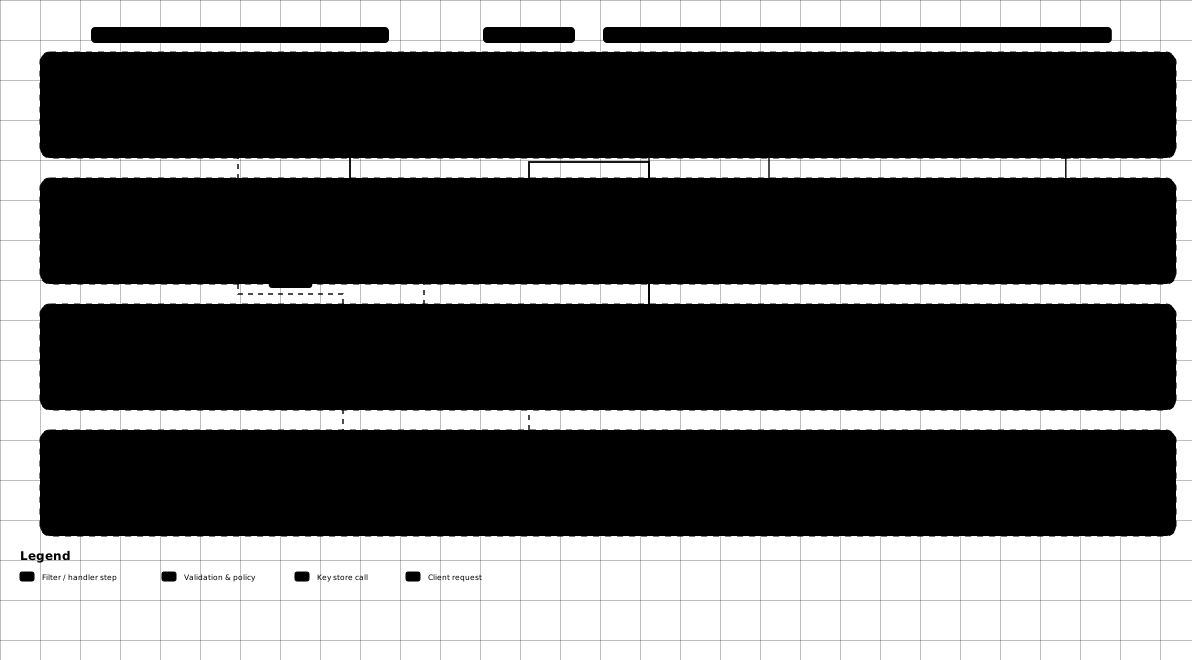
The three exits matter: a malformed key and a duplicate key both stop before the handler, and only a genuinely new key
reaches it. Note the asymmetry in failure handling — IsKeyProcessedAsync is not wrapped in a try/catch, so a store
outage on the duplicate check fails the request, while a failure while caching the response afterwards is caught and
logged and the client still gets its result.
Group-level declaration
RequiredIdempotentKey() has a second overload that extends RouteGroupBuilder, so one declaration covers every
matching endpoint in the group instead of repeating the call per route:
public static RouteGroupBuilder RequiredIdempotentKey(
    this RouteGroupBuilder group,
    params string[] httpMethods);   // omitted or empty => POST only
var orders = app.MapGroup("/api/orders").RequiredIdempotentKey();                 // POST endpoints only
var admin  = app.MapGroup("/api/admin").RequiredIdempotentKey("POST", "DELETE");  // explicit verb set

orders.MapPost("/", CreateOrder);            // protected — no per-endpoint call needed
orders.MapGet("/{id}", GetOrder);            // untouched: no header required, no duplicate lookup
orders.MapGroup("/{id}/lines")               // nested group inherits the same verb selection
      .MapPost("/", AddOrderLine);           // protected

admin.MapDelete("/tenants/{id}", DeleteTenant);  // protected too, because DELETE was named
What the declaration does and does not reach:
Endpoint in a group declared with RequiredIdempotentKey() (default) |
Covered? |
|---|---|
MapPost(...) — registered before or after the declaring call |
Yes |
MapPost(...) in a group nested under the declaring group, any depth |
Yes — at the same verb selection |
MapGet(...), MapPut(...), MapDelete(...) |
No — outside the covered verb set |
Map(...) with no verb constraint (also serves GET) |
No — no routed verb to match |
The default covered verb set is POST only. PUT and DELETE are idempotent by HTTP semantics already, so
they are opt-in: name them explicitly (RequiredIdempotentKey("POST", "DELETE")) when your handlers need the
protection anyway. Verbs are matched case-insensitively against the endpoint’s routed verb, so "post" and
"POST" are the same declaration.
Coverage is decided once at application start, from the declaration plus the endpoint’s routed verb — never
from anything the caller sends. A X-HTTP-Method-Override: GET on a covered POST route therefore cannot move
that endpoint out of coverage.
An endpoint whose verb is outside the set is left completely untouched: no header requirement, no 400, no
duplicate lookup, no response retained. Reads in a protected group keep working normally for clients that never
send an idempotency key, and a key sent to such an endpoint has no effect at all.
A covered endpoint behaves exactly like one declared individually — same header name, same key validation, same
duplicate handling, same retention, all still driven by IdempotencyOptions. The per-endpoint overload is
unchanged, and an endpoint covered by both a group declaration and its own RequiredIdempotentKey() is
protected exactly once: one handler invocation, one stored response, one duplicate report.
Composite key validation (400 Bad Request)
Before touching the store, the filter validates the incoming key against IdempotencyOptions:
- Presence – the header (
X-Idempotency-Keyby default) must be present and non-blank. - Length – must not exceed
MaxIdempotencyKeyLength(default 255). - Format – must match
IdempotencyKeyPattern(default^[a-zA-Z0-9\-_]+$, i.e. UUID-v4 compatible). The match runs under a fixed 100 ms timeout; a pattern that exceeds it is treated the same as a mismatch — the same400, not a hang or a500.
Any failure short-circuits the pipeline with a 400 Bad Request problem response — the handler never runs.
A custom
IdempotencyKeyPatternwith nested quantifiers (^([a-zA-Z0-9]+)+$is the classic accident) can still burn CPU on a long key before it times out. The 100 ms timeout is a backstop against a hang, not a fix for a pathological pattern — write the pattern to be linear in the first place.
app.MapPost("/orders", CreateOrder)
    .RequiredIdempotentKey(); // client omits the header, or sends 300 chars, or "bad key!" -> 400
Duplicate-request handling — two strategies
IdempotencyOptions.ConflictHandling controls what a client sees when the same composite key is reused:
builder.Services.AddIdempotentKey(options =>
{
    // Default: tell the client explicitly that this was already processed.
    options.ConflictHandling = IdempotentConflictHandling.ConflictResponse; // 409 Conflict

    // Or: silently replay the original response as if it just happened again.
    // options.ConflictHandling = IdempotentConflictHandling.CachedResult;
});
With CachedResult, the second request gets the exact status code, body, and content type of the first — read back
from the store, not recomputed.
Response caching (which results get remembered)
Only responses whose status code falls in [MinStatusCodeForCaching, MaxStatusCodeForCaching] (default 200–299)
or in AdditionalCacheableStatusCodes are cached; everything else (validation errors, 404s, etc.) is left
unrecorded so a genuinely failed attempt can be retried as a new request:
builder.Services.AddIdempotentKey(options =>
{
    // Also remember 201-with-redirect-style responses outside the 2xx window, e.g. 226.
    options.AdditionalCacheableStatusCodes.Add(226);
});
Caller scope isolation
Two different callers sending the identical idempotency key to the identical endpoint must not collide. By default,
IdempotencyKeyScopeResolver resolves a scope using a fallback chain:
- The authenticated user’s
ClaimTypes.NameIdentifier→user:{id}. - An HMAC-SHA256 digest of the
Authorizationheader, only whenScopeHmacSecretis configured →auth:{hash}. - The caller’s remote IP address, only when
IncludeClientIpInScopeistrue→ip:{address}. - Otherwise, an empty scope (all anonymous callers share one scope for that key/endpoint/method).
builder.Services.AddIdempotentKey(options =>
{
    options.ScopeHmacSecret = builder.Configuration["Idempotency:HmacSecret"];
    options.IncludeClientIpInScope = true; // last-resort fallback for fully anonymous callers
});
The raw Authorization header and the HMAC secret are never logged or persisted — only the resulting digest is used.
Custom scope resolver
Supply your own resolver to bypass the default chain entirely — useful for multi-tenant scoping by tenant ID, API key, or any other principal your app already tracks:
builder.Services.AddIdempotentKey(options =>
{
    options.KeyScopeResolver = ctx => ctx.Request.Headers["X-Tenant-Id"].FirstOrDefault();
});
When KeyScopeResolver is set, it is used verbatim and the default chain (user claim, HMAC, IP) is skipped.
Pluggable store abstraction
The filter depends only on IIdempotencyKeyStore (namespace DKNet.AspCore.Idempotency.Store):
public interface IIdempotencyKeyStore
{
    ValueTask<(bool processed, CachedResponse? response)> IsKeyProcessedAsync(IdempotentKeyInfo keyInfo);
    ValueTask MarkKeyAsProcessedAsync(IdempotentKeyInfo keyInfo, CachedResponse cachedResponse);
}
This is the package’s one real extension point, and it carries a contract the compiler cannot enforce. A custom store must guarantee all four of the following:
- Atomic check-and-reserve.
IsKeyProcessedAsyncreturning(false, null)must have already durably recorded that this composite key is in flight, in the same indivisible operation that observed it absent. A unique index insert, a RedisSET NX, or a compare-and-swap all qualify; aGetfollowed by a separateSetdoes not. If you get this wrong: two concurrent requests both observe(false, null), both run the handler, and the side effect the filter exists to protect happens twice. - An in-flight reservation placeholder. The reservation written in step 1 must be distinguishable from a
completed response, so that a concurrent duplicate is answered
(true, null)— “already in flight, no cached response yet” — rather than(true, someResponse). Every shipped store uses HTTP102 Processingas that sentinel. If you get this wrong: the filter’sCachedResultstrategy replays an empty or half-written body as though it were the original response. - A bounded reservation lifetime. The placeholder must expire after
IdempotencyOptions.InFlightReservationTimeout(default 30 seconds), and an expired one must be reclaimable — again atomically. If you get this wrong: a handler that crashes mid-flight blocks that key permanently, and the caller can never retry. - Distinct keys stay distinct.
IdempotentKeyInfo.CompositeKeyisScope:Method:Endpoint:Keyand is free-form caller input. Hash it (every shipped store uses SHA-256) rather than escaping or truncating it, so two structurally different composite keys can never collapse onto one storage key.
MarkKeyAsProcessedAsync has no atomicity requirement — the filter calls it once, from the caller that won the
reservation, and it should overwrite that caller’s placeholder with the completed response.
using DKNet.AspCore.Idempotency.Filtering;
using DKNet.AspCore.Idempotency.Store;

public sealed class MyIdempotencyKeyStore : IIdempotencyKeyStore
{
    public ValueTask<(bool processed, CachedResponse? response)> IsKeyProcessedAsync(IdempotentKeyInfo keyInfo)
    {
        // Atomically: if no live entry exists for keyInfo.CompositeKey, write a reservation and return
        // (false, null); otherwise return (true, null) while it is a reservation, or (true, response)
        // once it holds a completed response.
        throw new NotImplementedException();
    }

    public ValueTask MarkKeyAsProcessedAsync(IdempotentKeyInfo keyInfo, CachedResponse cachedResponse)
    {
        // Overwrite this caller's reservation with cachedResponse, expiring after IdempotencyOptions.Expiration.
        throw new NotImplementedException();
    }
}

// Register it in place of the in-process default store:
builder.Services.AddIdempotentKey<MyIdempotencyKeyStore>();
CachedResponse is what a store round-trips. Every member is required on construction:
| Member | Type | Meaning |
|---|---|---|
StatusCode |
int |
The original response’s status code, replayed verbatim. 102 is reserved for the in-flight sentinel. |
Body |
string? |
The serialized response body, or null for a body-less response. |
ContentType |
string |
The original content type; the filter falls back to "application/json" when the response did not set one. |
CreatedAt |
DateTimeOffset |
When the entry was written (UTC). |
ExpiresAt |
DateTimeOffset? |
When it stops being valid, or null for no expiry. |
IsExpired |
bool (derived) |
true once a non-null ExpiresAt has passed. Stores are expected to honour it on read. |
IdempotentKeyInfo is what a store receives. Endpoint and Method are required; both are already
upper-invariant when the filter builds one:
| Member | Type | Meaning |
|---|---|---|
IdempotentKey |
string? |
The raw header value, or null when the header was absent. |
Endpoint |
string |
Route template (RoutePattern.RawText, then IRouteDiagnosticsMetadata.Route, then the request path), upper-invariant. |
Method |
string |
HTTP method, upper-invariant. |
Scope |
string |
Caller scope; string.Empty for an unscoped anonymous caller. |
CompositeKey |
string (derived) |
$"{Scope}:{Method}:{Endpoint}:{IdempotentKey}" — the value to hash and store under. |
SafeKey |
string (derived) |
IdempotentKey with CR/LF/U+2028/U+2029 and every other control character stripped. Logging and display only — never use it as a storage key. |
IsValid(IdempotencyOptions) |
IResultBase |
The presence/length/pattern check the filter runs before touching the store. |
In-flight reservation window
While a handler is still running for a brand-new key, every shipped store — the in-process default included —
writes a short-lived reservation record (HTTP 102 Processing sentinel) so a concurrent duplicate sees “already in
flight” instead of also slipping through as new. InFlightReservationTimeout (default 30 seconds) bounds how long
that reservation is honored before a crashed or hung handler stops blocking retries of the same key:
builder.Services.AddIdempotentKey(options =>
{
    options.InFlightReservationTimeout = TimeSpan.FromSeconds(10); // fail fast for quick handlers
});
Cache namespacing and expiration
CachePrefix (default "idem") namespaces cache keys to avoid collisions with unrelated cached data, and
Expiration (default 4 hours) is the absolute lifetime of a cached idempotency result before the same key is treated
as brand-new again:
builder.Services.AddIdempotentKey(options =>
{
    options.CachePrefix = "checkout-idem";
    options.Expiration = TimeSpan.FromHours(24);
});
In-process store startup warning
AddIdempotentKey() also registers an internal startup service (IdempotencyInMemoryStoreWarning, an
IHostedLifecycleService) that logs exactly one warning per application start — and only while the resolved
IIdempotencyKeyStore is the in-process default store:
warn: DKNet.AspCore.Idempotency.Store.IdempotencyInMemoryStoreWarning[0]
      Idempotency keys are stored in the process's memory (IdempotencyInMemoryStore): they are lost on restart
      and are not shared between instances. ...
The warning exists because those keys live in one process’s memory: they are lost on restart and never reach a
second instance, so an accidental multi-instance deployment on the default store is visible in the logs on the
first start instead of only when a duplicate slips through. Registering any other store —
AddIdempotentKey<TStore>() or a provider package’s AddIdempotencyWithXxxStore(...) — silences it, because the
resolved store is then no longer IdempotencyInMemoryStore.
The service checks the store in the start moment only; the remaining lifecycle moments (starting, started,
stopping, stop, stopped) do no work. It is internal, so there is nothing to register, configure, or suppress from
application code — pick a durable store and the warning is gone.
⚙️ Configuration reference
All options live on IdempotencyOptions, configured via the Action<IdempotencyOptions> passed to
AddIdempotentKey(), AddIdempotentKey<TStore>(), or a provider package’s AddIdempotencyWithXxxStore(...). The
in-process default store adds no options of its own — it reuses Expiration and InFlightReservationTimeout, and
holds no key past its Expiration.
| Option | Default | Purpose |
|---|---|---|
IdempotencyHeaderKey |
"X-Idempotency-Key" |
Header the filter reads the key from. |
IdempotencyKeyPattern |
^[a-zA-Z0-9\-_]+$ |
Regex a key must match to be accepted; matched under a fixed 100 ms timeout — a pattern that times out is treated as a mismatch (400). |
MaxIdempotencyKeyLength |
255 |
Maximum accepted key length. |
ConflictHandling |
ConflictResponse |
ConflictResponse (409) or CachedResult (replay). |
Expiration |
4 hours |
Absolute lifetime of a cached result. |
InFlightReservationTimeout |
30 seconds |
How long an in-flight reservation blocks a retry before expiring. |
MinStatusCodeForCaching / MaxStatusCodeForCaching |
200 / 299 |
Inclusive status-code range eligible for caching. |
AdditionalCacheableStatusCodes |
(empty) | Extra status codes to cache outside the min/max range. |
CachePrefix |
"idem" |
Prefix applied to every cache key. |
JsonSerializerOptions |
camelCase naming policy | Used to serialize/deserialize cached response bodies. |
KeyScopeResolver |
null |
Custom caller-scope resolver; bypasses the default chain when set. |
ScopeHmacSecret |
null |
Enables the Authorization-header HMAC fallback in the default scope chain. |
IncludeClientIpInScope |
false |
Enables the client-IP fallback in the default scope chain. |
Both AddIdempotentKey() overloads register IdempotencyOptions through the options pattern with ten .Validate(...)
rules (empty header key, empty cache prefix, non-positive expiration, an out-of-range status window, a null
JsonSerializerOptions, etc.) plus .ValidateOnStart(). That means misconfiguration no longer throws at
registration time — it throws OptionsValidationException when the host starts (before it begins serving
requests), which is still well before any request can observe a bad value, just later in the startup sequence than
before.
🧱 Where it fits
FluentResults–IdempotentKeyInfo.IsValidreturns anIResultBase, following the same result pattern used across DKNet.- Pairs naturally with
DKNet.AspCore.Tasks(start-up jobs) and other ASP.NET Core hardening utilities in the sameAspNet/area to build resilient web APIs on top of DKNet’s DDD/Onion architecture. - Defines the storage abstraction (
IIdempotencyKeyStore) that the store ecosystem below implements.
🗄️ Choosing a store
This package owns the endpoint filter, options, and the store contract (IIdempotencyKeyStore). It ships exactly
one store implementation — an in-process store for local development and unit tests — and four sibling packages
provide alternatives that hold keys outside the process:
| Store | Package | How you select it | Atomicity | Infra cost | Best for |
|---|---|---|---|---|---|
| In-process (built-in default) | DKNet.AspCore.Idempotency |
AddIdempotentKey() — no type argument |
Atomic, but only within one process | None at all — no database, cache, Redis, or connection string | Local development and unit tests. Keys are process-local, lost on restart, and not shared between instances, so never production |
| Relational (base) | DKNet.AspCore.Idempotency.Relational |
Not selectable — every type in it is internal and its InternalsVisibleTo list is closed |
Atomic via a unique index / insert-or-query pattern | Shared EF Core building blocks for the two SQL stores below | Nothing to register; read it only to add a new relational provider inside this repo |
| SQL Server | DKNet.AspCore.Idempotency.MsSqlStore |
AddIdempotencyWithMsSqlStore(connectionString, options) |
Atomic (unique index) | A migrated table in an existing SQL Server database | Apps already running SQL Server that want an auditable, queryable idempotency table |
| PostgreSQL | DKNet.AspCore.Idempotency.NpgsqlStore |
AddIdempotencyWithNpgsqlStore(connectionString, options) |
Atomic (unique index) | A migrated table in an existing PostgreSQL database | Apps already running PostgreSQL, same trade-offs as the SQL Server store |
| Redis | DKNet.AspCore.Idempotency.RedisStore |
AddIdempotencyWithRedisStore(connectionString, options) |
Atomic (native Redis primitives, e.g. SET NX) |
A Redis instance/cluster | High-throughput APIs, multi-instance deployments, when you don’t want schema migrations |
| Your own | — | AddIdempotentKey<TStore>(options) |
Whatever you implement — see Pluggable store abstraction | Yours | A backing store none of the above covers |
Guidance:
- Start on the in-process default store (
AddIdempotentKey()) while you are developing or unit-testing: it needs no infrastructure and reserves each key atomically, so the filter behaves exactly as it will in production for a single process. What it does not do is survive a restart or reach a second instance — the keys live in that process’s own memory. It logs one startup warning saying so while it is the store serving requests, which is what makes an accidental multi-instance deployment on it visible; naming any other store silences the warning. - Do not plan on subclassing
DKNet.AspCore.Idempotency.Relational. Every type in it isinternal, and itsInternalsVisibleTolist names only the two in-repo provider packages and their test projects. A store of your own implementsIIdempotencyKeyStoredirectly, the way the Redis store does. - Pick a relational store (MsSql/Npgsql) when the app already runs that relational database, you want the idempotency ledger to live alongside your business data (same backups, same transactional boundary tooling), or you want to query/audit processed keys with SQL. Concurrency correctness comes from a unique index plus an insert-or-query pattern — see the store’s own page for the exact schema.
- Pick Redis when you need the lowest latency and highest throughput (no database round-trip / query planner), you’re scaling horizontally across many instances, or you’d rather avoid owning a migrated table at all. Redis’s native atomic commands give the same all-or-nothing guarantee as a unique index without a schema.
- TTL/expiry: the in-process store drops each key once
Expirationhas elapsed and releases the memory with it, so the same key is treated as brand-new again — and the memory it holds is bounded by the keys still inside that window. Redis TTLs expire keys natively with the same “silently becomes new” behavior once the TTL elapses. Relational stores need an explicit expiry column and a cleanup strategy (a scheduled sweep or query filter) because SQL Server/PostgreSQL rows don’t expire themselves — see each store’s page for its approach. - Concurrency: every shipped store reserves a key atomically, so two simultaneous requests for the same key can never both slip through as “new”. The difference is scope, not correctness: the in-process store guarantees that within one process only, while the relational and Redis stores guarantee it across every instance sharing the database or Redis.
The four store pages link back to this section instead of repeating the comparison — update it here first.
⚠️ Gotchas & limits
- Default conflict handling is
409, not replay. If you expect a duplicate request to transparently get the original response back, you must opt intoConflictHandling = IdempotentConflictHandling.CachedResult— the default explicitly tells the caller the request was already processed. - The in-process default store is not safe for multi-instance production traffic. Its atomicity stops at the process boundary: two instances each keep their own key ledger, so the same key can be processed once per instance, and a restart forgets every key it held. Use a relational or Redis store (above) as soon as you run more than one instance. The startup warning it logs is there to catch exactly that deployment mistake.
- A store failure during the duplicate check is not caught.
IsKeyProcessedAsyncruns with no surrounding try/catch in the filter, so a store outage (e.g. cache/DB unavailable) propagates as an unhandled exception and the request fails — there is currently no configurable fail-open/fail-closed toggle for this path. By contrast, a failure while caching the response after a successful handler run (MarkKeyAsProcessedAsync/serialization) is caught and logged — the original response still reaches the client even if it couldn’t be cached for future replay. - Minimal APIs only.
RequiredIdempotentKey()extendsRouteHandlerBuilderandRouteGroupBuilder, so it wires up throughapp.MapPost(...)/MapPut(...)/app.MapGroup(...)etc. It is not something you attach to an MVC controller action via attributes. - A group declaration does not reach a verb-less endpoint. An endpoint registered with
app.Map(...)(orgroup.Map(...)) carries no routed verb, so a group declaration — default or explicit — cannot match it and it stays unprotected even though it acceptsPOST. Declare explicit verbs (MapPost,MapPut, …) on endpoints you want a group to protect. - A group’s verb set is the only control, and omissions are silent. There is no per-endpoint opt-out inside a
protected group, and equally no warning when a state-changing endpoint falls outside the set you named — a
MapPutin a group declaredRequiredIdempotentKey()(POST-only default) is simply unprotected. That is an explicit choice; check the verb set against the group’s mutating routes. - Registration between two named stores is call-once-wins, config delegate included. If a named store is
registered more than once (e.g. by two library extension methods, or by an app calling
AddIdempotentKey<TStore>()after a store package’s ownAddIdempotencyWithXxxStore(...)), the first call’s store registration sticks and only the first call’sconfigdelegate ever runs — a second call’sconfigis silently never invoked, not merged, not overridden. Validation failures surface viaOptionsValidationExceptionwhen the host starts (ValidateOnStart()), not at the moment the registration call runs. - The in-process default is the one exception to call-once-wins. A named store registered after
AddIdempotentKey()replaces the default rather than being ignored, and it is that named registration’sconfigdelegate that decides any option both calls set. In the other direction,AddIdempotentKey()called when any store is already registered is a complete no-op — including itsconfig. - Cache keys are hashed, not human-readable. The in-process store’s key is
CachePrefix+ a SHA-256 hex digest of the composite key — you cannot reconstruct the original key/scope/endpoint from the cache key alone; rely on structured logs (which log the raw composite key) if you need to trace a specific request.
🔗 Related packages
- DKNet.AspCore.Idempotency.Relational – shared EF Core base for building a relational store.
- DKNet.AspCore.Idempotency.MsSqlStore – atomic SQL Server-backed store.
- DKNet.AspCore.Idempotency.NpgsqlStore – atomic PostgreSQL-backed store.
- DKNet.AspCore.Idempotency.RedisStore – atomic Redis-backed store.
- DKNet.AspCore.Tasks – start-up background job orchestration for the same
AspNet/area.