DKNet
DKNet.AspCore.Idempotency.RedisStore
Redis-backed IIdempotencyKeyStore for
DKNet.AspCore.Idempotency, implemented directly against
StackExchange.Redis with SET NX reservation and native key expiry.
✨ Why use it?
- Atomic reservation with no schema.
SET NXgives exactly one concurrent caller the right to proceed, the same all-or-nothing guarantee a relational unique index gives — without a table, a migration, or a design-time factory to own. - Lowest latency of the shipped stores. No database round-trip and no query planner on the hot path of every idempotency-protected request.
- Expiry is free. Both the in-flight reservation window and the completed-response lifetime are Redis TTLs, so there is no cleanup job to host — unlike the relational stores, which need one.
- Built for horizontal scale. Unlike the core package’s built-in in-process store, whose keys never leave one process, this one is safe for multi-instance production traffic.
Reach for Redis over a relational store when you already run Redis and want the lowest-latency option with no schema to manage. See Choosing a store on the core page for the full Redis-vs-relational comparison.
🚀 Quick Start
dotnet add package DKNet.AspCore.Idempotency.RedisStore
using DKNet.AspCore.Idempotency;
using DKNet.AspCore.Idempotency.RedisStore;

var builder = WebApplication.CreateBuilder(args);

builder.Services.AddIdempotencyWithRedisStore(
    builder.Configuration.GetConnectionString("Redis")!,
    options =>
    {
        options.Expiration = TimeSpan.FromHours(48);
    });

var app = builder.Build();

app.MapPost("/orders", CreateOrder)
    .RequiredIdempotentKey();

await app.RunAsync();
AddIdempotencyWithRedisStore registers IDistributedCache and IConnectionMultiplexer for the
given connection string — skipping either if your app already registered one — and then calls
AddIdempotentKey<IdempotencyRedisStore>(), wiring IdempotencyRedisStore as the
IIdempotencyKeyStore the endpoint filter uses.
If your app already owns an IConnectionMultiplexer, hand it over first; the registration above
then reuses it instead of connecting a second one:
builder.Services.AddIdempotencyRedisStore(existingMultiplexer);

builder.Services.AddIdempotencyWithRedisStore(
    builder.Configuration.GetConnectionString("Redis")!,
    options =>
    {
        options.Expiration = TimeSpan.FromHours(48);
    });
🧩 Features
Registration entry points
IdempotencyRedisSetup is the package’s only public type. It declares three extension methods on
IServiceCollection, and only the third one wires up the key store:
| Method | Registers | Guard |
|---|---|---|
AddIdempotencyRedisStore(string connectionString) |
IDistributedCache via AddStackExchangeRedisCache, and a singleton IConnectionMultiplexer built with ConnectionMultiplexer.Connect(connectionString) |
Each of the two is registered only when nothing is registered for it yet — they are guarded independently, so an app that already owns one still gets the other. |
AddIdempotencyRedisStore(IConnectionMultiplexer connectionMultiplexer) |
The supplied multiplexer as a singleton | Returns early if any IConnectionMultiplexer is already registered. Registers no IDistributedCache. |
AddIdempotencyWithRedisStore(string connectionString, Action<IdempotencyOptions>? config = null) |
Calls the connection-string overload, then AddIdempotentKey<IdempotencyRedisStore>(config) |
First-wins on IIdempotencyKeyStore, as everywhere else. |
The first two throw ArgumentNullException on a null services (and on a null multiplexer); the
connection-string overloads also throw ArgumentException on an empty or whitespace connection string.
What the package creates, and what you provide
| Thing | Who provides it |
|---|---|
| Key layout, reservation entries and TTLs | The package — nothing is provisioned ahead of time, and there is no schema, migration or design-time factory |
| A reachable Redis instance or cluster | You |
| Redis memory sizing and its eviction policy | You — an eviction under memory pressure silently makes a key look new again |
| Key-space isolation from unrelated data | You, via IdempotencyOptions.CachePrefix |
Key format and prefixing
Every composite key (Scope:Method:Endpoint:IdempotentKey) is hashed with SHA-256 and rendered as
lowercase hex before it becomes a Redis key, so structurally different composite keys never collide
and no raw request data ends up in a Redis key name. The configured prefix
(IdempotencyOptions.CachePrefix, default "idem") is prepended unchanged:
// Redis key = $"{options.CachePrefix}{lowercase-sha256-hex(keyInfo.CompositeKey)}"
builder.Services.AddIdempotencyWithRedisStore(connectionString, options =>
{
    options.CachePrefix = "myapp:idem:";
});
TTL and expiry handling
Two windows, both enforced as native Redis TTLs — there is no background sweep:
- In-flight reservations use
IdempotencyOptions.InFlightReservationTimeout(default 30s) as the key’s TTL on the reservationSET NX, so a crashed handler’s reservation self-expires and a later caller is not blocked forever. - Completed responses use
IdempotencyOptions.Expiration(default 4h) as the key’s TTL on the unconditionalSETperformed byMarkKeyAsProcessedAsync.
The store additionally checks CachedResponse.IsExpired on read and calls KeyDeleteAsync if a
logically expired entry is still physically present (e.g. an explicit ExpiresAt shorter than the
Redis TTL):
var store = app.Services.GetRequiredService<IIdempotencyKeyStore>();
var keyInfo = new IdempotentKeyInfo { Endpoint = "/API/ORDERS", Method = "POST", IdempotentKey = "abc-123" };

await store.MarkKeyAsProcessedAsync(keyInfo, new CachedResponse
{
    StatusCode = 201,
    Body = "{\"id\":1}",
    ContentType = "application/json",
    CreatedAt = DateTimeOffset.UtcNow,
    ExpiresAt = DateTimeOffset.UtcNow.AddHours(48)
});
Atomic reservation
IsKeyProcessedAsync reserves a key with SET NX, giving exactly one concurrent caller the right
to proceed — proven under ten genuinely concurrent callers for the same key in
IdempotencyRedisStoreConcurrencyTests.IsKeyProcessedAsync_ConcurrentRequestsWithSameKey_OnlyOneReservationWins
(1 winner, 9 collisions):
var (processed, cachedResponse) = await store.IsKeyProcessedAsync(keyInfo);
if (!processed)
{
    // This call won the reservation and must now run the handler and call
    // MarkKeyAsProcessedAsync — every other concurrent caller for the same key gets processed = true.
}
Cache-decision logic
When the reservation SET NX loses the race, the store re-reads the winner’s entry and decides what
a losing caller sees (see IdempotencyRedisStoreDecisionTests for the full branch table):
| Winner’s entry on re-read | Result to the losing caller |
|---|---|
Still in-flight (HTTP 102 sentinel) |
(true, null) — caller should wait/retry |
| Completed | (true, cachedResponse) — replay the original response |
| Logically expired | Entry is deleted; caller proceeds as new: (false, null) |
Gone (evicted between the failed SET and the re-read) |
Caller proceeds as new: (false, null) |
var (processed, cachedResponse) = await store.IsKeyProcessedAsync(keyInfo);
if (processed && cachedResponse is not null)
{
    // Replay cachedResponse.StatusCode / Body / ContentType instead of re-running the handler.
}
⚙️ Configuration reference
There is no Redis-specific options type. IdempotencyRedisStore reads these IdempotencyOptions,
configured via the config delegate on AddIdempotencyWithRedisStore; the full option set lives in
the core configuration reference:
| Option | Default | Used for |
|---|---|---|
CachePrefix |
"idem" |
Prefix on every Redis key |
Expiration |
4 hours | TTL on completed-response entries |
InFlightReservationTimeout |
30 seconds | TTL on reservation entries |
JsonSerializerOptions |
camelCase | Serializing CachedResponse to/from the Redis string value |
🧱 Where it fits
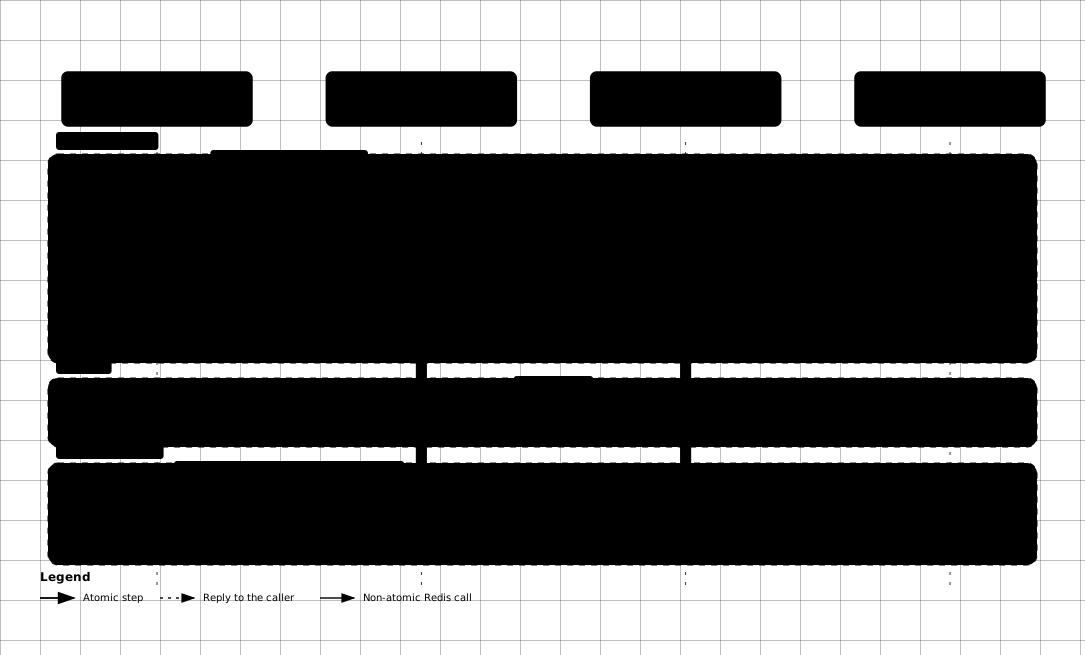
This package supplies only the IIdempotencyKeyStore implementation. Key validation, the endpoint
filter, conflict handling (ConflictHandling), and scope resolution all come from
DKNet.AspCore.Idempotency unchanged — see that package’s page for
the endpoint-level behaviour this store plugs into.
Unlike the SQL Server and PostgreSQL stores, it does not derive from
DKNet.AspCore.Idempotency.Relational:
IdempotencyRedisStore implements IIdempotencyKeyStore directly against StackExchange.Redis,
using SET NX for reservation and Redis TTLs instead of SQL rows and scheduled cleanup.
⚠️ Gotchas & limits
IdempotencyRedisStoreisinternal. You cannot name it, soAddIdempotentKey<IdempotencyRedisStore>(...)is not something app code can write —AddIdempotencyWithRedisStore(...)is the only way to wire this store in. The publicAddIdempotencyRedisStore(...)overloads register the Redis infrastructure only; on their own they leave whateverIIdempotencyKeyStoreis already registered in place — the core package’s in-process default store, if that is all the app registered.AddIdempotencyRedisStore(connectionString)also registersIDistributedCache(viaAddStackExchangeRedisCache) even though this store does not use it — it talks toIConnectionMultiplexerdirectly. Harmless, but it is a service registration you did not ask for; pass an existing multiplexer first if you want to control that.- Registration is first-wins. Each of
IDistributedCache,IConnectionMultiplexer, andIIdempotencyKeyStoreis registered only when nothing is registered for it yet, so a second call with a different connection string is silently a no-op. - No relational query-ability. You cannot ad-hoc query cached responses by scope, endpoint, or date range as you could with a SQL table — Redis only supports lookup by the hashed key, and the hash is one-way.
- Retention is fixed at write time. Expiry is enforced by Redis’s own TTL, not application code,
so there is no cleanup job to host — but you also cannot tweak retention for already-written
entries without a manual
KeyDeleteAsync/redis-clioperation. - Redis availability is a hard dependency. Every idempotency-protected endpoint call goes
through
IIdempotencyKeyStore, and this package has no in-memory or local fallback if Redis is unreachable.
🔗 Related packages
- DKNet.AspCore.Idempotency — the core package this store plugs into; start there to wire idempotency into an app at all.
- DKNet.AspCore.Idempotency.MsSqlStore — reach for it instead when you want the key ledger in SQL Server, queryable and backed up with your business data.
- DKNet.AspCore.Idempotency.NpgsqlStore — the same trade-off on PostgreSQL.
- DKNet.AspCore.Idempotency.Relational — the base the two SQL stores share; this package does not use it.