DKNet
DKNet.AspCore.Idempotency.MsSqlStore
SQL Server-backed IIdempotencyKeyStore for
DKNet.AspCore.Idempotency, built on the shared
relational base.
✨ Why use it?
- Idempotency keys survive restarts and scale-out without standing up Redis — they live in a SQL Server table alongside your business data, with the same backups and the same operational tooling.
- Atomic across instances. The unique index
UX_CompositeKeymakes duplicate-request reservation race-free for every instance sharing the database — the core package’s built-in in-process store guarantees that within one process only. - Auditable. Unlike a Redis store, the processed-key ledger is an ordinary table you can query: which key, which endpoint, which verb, what status code, when it expires.
- One registration call.
AddIdempotencyWithMsSqlStore(connectionString)registers theDbContext, its factory, and the store; migrations apply themselves on first use.
Reach for this store when SQL Server is already part of your stack — see Choosing a store on the core page for the full Redis-vs-relational comparison, which is not repeated here.
🚀 Quick Start
dotnet add package DKNet.AspCore.Idempotency.MsSqlStore
using DKNet.AspCore.Idempotency;
using DKNet.AspCore.Idempotency.MsSqlStore;

var builder = WebApplication.CreateBuilder(args);

builder.Services.AddIdempotencyWithMsSqlStore(
    builder.Configuration.GetConnectionString("IdempotencyDb")!,
    options =>
    {
        options.Expiration = TimeSpan.FromHours(48);
        options.ConflictHandling = IdempotentConflictHandling.CachedResult;
    });

var app = builder.Build();

app.MapPost("/orders", CreateOrder)
    .RequiredIdempotentKey();

await app.RunAsync();
AddIdempotencyWithMsSqlStore (in IdempotencyMsSqlSetup) does three things: it calls
AddIdempotencyMsSqlStore(connectionString) to register IdempotencyDbContext — a scoped
AddDbContext with a singleton DbContextOptions, plus an
IDbContextFactory<IdempotencyDbContext> — and a hosted service that migrates the schema once at
application startup (IdempotencyMigrationHostedService<IdempotencyDbContext>); and then
AddIdempotentKey<IdempotencySqlServerStore>(config) to wire the store in as the
IIdempotencyKeyStore. Call it once at start-up, then use .RequiredIdempotentKey() on endpoints
as described on the core page.
🧩 Features
Registration entry points
IdempotencyMsSqlSetup is the package’s only public type, and it declares exactly two extension methods on
IServiceCollection:
| Method | Registers | Does not register |
|---|---|---|
AddIdempotencyMsSqlStore(string connectionString) |
IdempotencyDbContext via AddDbContext (scoped context, singleton DbContextOptions), AddDbContextFactory<IdempotencyDbContext>, and IdempotencyMigrationHostedService<IdempotencyDbContext> (migrates at startup) |
The key store. Called on its own, no IIdempotencyKeyStore exists and RequiredIdempotentKey() cannot resolve the filter’s dependency. |
AddIdempotencyWithMsSqlStore(string connectionString, Action<IdempotencyOptions>? config = null) |
Everything the first method does, then AddIdempotentKey<IdempotencySqlServerStore>(config) |
Nothing — this is the call an application makes. |
Both throw ArgumentNullException on a null services and ArgumentException on a null, empty or
whitespace connection string. Both are first-wins: AddIdempotencyMsSqlStore returns early once
IdempotencyDbContext is registered, and AddIdempotentKey<TStore> returns early once any
IIdempotencyKeyStore is registered, so a second call with a different connection string is silently a no-op.
IdempotencySqlServerStore is internal, so AddIdempotentKey<IdempotencySqlServerStore>() is not something
application code can write — AddIdempotencyWithMsSqlStore(...) is the supported way in. Reach for the
AddIdempotencyMsSqlStore(...) overload on its own only when you want the DbContext registered without
replacing the key store — for example to run Database.MigrateAsync() from a start-up job.
What the package creates, and what you provide
| Thing | Who provides it |
|---|---|
The IdempotencyKeys table, UX_CompositeKey, IX_IdempotencyKeys_ExpiresAt and CK_StatusCode_Valid |
The package — created by the shipped Initial migration |
| Applying that migration | The package, automatically, once at application startup via a hosted service (or you, ahead of time — see Gotchas & limits) |
The migrate.IdempotencyDbContext migrations-history table and the migrate schema |
The package, through EF Core |
| A reachable SQL Server database and a login that can create tables in it | You |
| Row expiry / cleanup of keys nobody ever retries | You — ExpiresAt is indexed, but nothing sweeps it |
| Backup, retention and PII policy for cached response bodies | You — Body holds the serialized response verbatim |
The IdempotencyKeys table
The Initial migration creates one table:
| Column | Type | Notes |
|---|---|---|
Id |
uniqueidentifier |
Primary key PK_IdempotencyKeys |
CompositeKey |
nvarchar(128) |
Unique — see below |
Endpoint |
nvarchar(250) |
|
IdempotentKey, Method |
varchar(150) / varchar(20), non-Unicode |
|
Body |
nvarchar(max), max 1,048,576 chars |
SQL Server override of the shared entity mapping |
ContentType |
varchar(256), non-Unicode |
Nullable |
StatusCode |
int |
CK_StatusCode_Valid check constraint, 100–599 |
CreatedAt, ExpiresAt |
datetimeoffset |
ExpiresAt nullable |
Atomic reservation via UX_CompositeKey
Two indexes back the store’s behaviour. UX_CompositeKey (unique, on CompositeKey) is what makes
the reserve-then-insert flow in the relational base race-free — only one concurrent insert for the
same key succeeds; every other caller hits a unique violation and reads the winner’s row back
instead of proceeding. IX_IdempotencyKeys_ExpiresAt speeds up the expired-reservation reclaim.
IdempotencySqlServerStore classifies that collision by SqlException.Number — 2601 (duplicate
key in a unique index) or 2627 (unique/primary key constraint violation) — never by message text,
which is localized by the server’s login language:
protected override bool IsProviderUniqueViolation(DbUpdateException ex) =>
    ex.InnerException is SqlException { Number: 2601 or 2627 };
See IdempotencySqlServerStoreUniqueViolationTests for the exact scenarios this guards against.
Design-time tooling
IdempotencyDbContext here is the shared relational context closed over SQL Server’s
DbContextOptions. DbContextFactory (an IDesignTimeDbContextFactory<IdempotencyDbContext>)
exists only so dotnet ef design-time tooling can build a context outside your app’s DI container
— it reads its connection string from the IDEMPOTENCY_MSSQL_CONNECTION environment variable, not
from app configuration, and throws InvalidOperationException when that variable is unset.
⚙️ Configuration reference
There is no SQL-Server-specific options type — AddIdempotencyWithMsSqlStore configures the same
IdempotencyOptions the core package defines (Expiration, ConflictHandling,
InFlightReservationTimeout, …); see the
core configuration reference.
What SQL Server itself gets is fixed by this package rather than exposed as options:
| Setting | Value | Effect |
|---|---|---|
EnableRetryOnFailure |
3 retries, 5 seconds apart |
Transient-fault resilience on idempotency queries. |
UseQuerySplittingBehavior |
QuerySplittingBehavior.SplitQuery |
EF Core split-query mode for this context. |
MigrationsAssembly |
this package’s assembly | Migrations ship with the store, not with your app. |
MigrationsHistoryTable |
[migrate].[IdempotencyDbContext] |
Separate from your app’s own __EFMigrationsHistory. |
optionsLifetime |
ServiceLifetime.Singleton |
Options are shared; the DbContext itself stays scoped. |
🧱 Where it fits
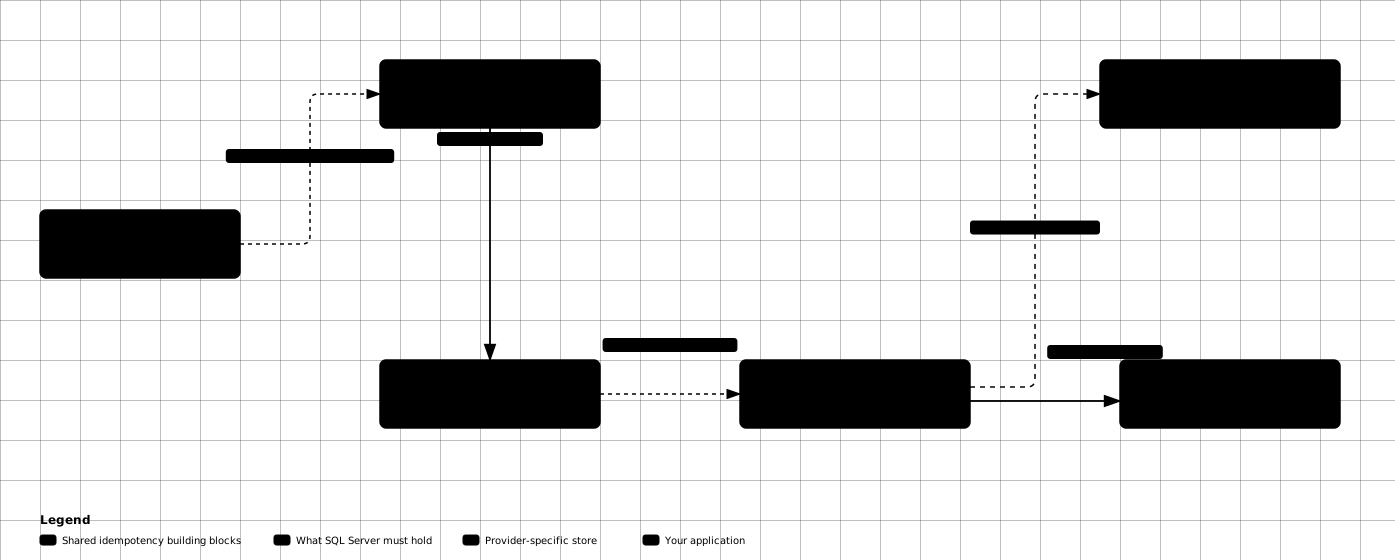
This package supplies only what is provider-specific: the closed IdempotencyDbContext, the SQL
Server column type and check-constraint SQL for IdempotencyKeyConfiguration, the Initial
migration, and IdempotencySqlServerStore.IsProviderUniqueViolation. Everything else — the
reserve/check/complete flow, the migration guard, the expired-reservation reclaim — lives in
DKNet.AspCore.Idempotency.Relational; the HTTP-facing
pieces (endpoint filter, key scope resolution, IdempotencyOptions) live in
DKNet.AspCore.Idempotency.
⚠️ Gotchas & limits
- Migration ownership — migrations ship inside this package’s own assembly
(
sqlOptions.MigrationsAssembly(typeof(IdempotencyMsSqlSetup).Assembly)); don’t add your ownIdempotencyDbContextmigrations to your application’s assembly. - Migrations run automatically, with no opt-out —
AddIdempotencyMsSqlStoreregistersIdempotencyMigrationHostedService<IdempotencyDbContext>, which applies any pending migrations once, inStartAsync, before the host begins serving requests. This requires the host to actually run hosted services (a normalWebApplication.RunAsync()/Run()does); a host that skips or reorders hosted services instead falls back to the relational base’s per-request guard, which checks for and applies pending migrations under a lock the first time the store is used against a given connection string — see DKNet.AspCore.Idempotency.Relational. For a controlled production rollout instead of either automatic path, setIDEMPOTENCY_MSSQL_CONNECTIONand rundotnet ef database update --context IdempotencyDbContextfrom a project that references this package before traffic arrives. - Registration is first-wins —
AddIdempotencyMsSqlStorereturns early onceIdempotencyDbContextis registered, andAddIdempotentKey<TStore>returns early once anIIdempotencyKeyStoreis registered. A second call with a different connection string is silently a no-op. - Nothing purges expired rows.
ExpiresAtis indexed and expired rows are reclaimed opportunistically when a request collides with one, but the table grows until you add your own cleanup job for keys that are never retried. - Every protected request costs a database round-trip. If your SQL Server is a bottleneck or the endpoint is very high-throughput, the Redis store avoids the query planner entirely.
🔗 Related packages
- DKNet.AspCore.Idempotency — the core package this store plugs into; start there to wire idempotency into an app at all.
- DKNet.AspCore.Idempotency.NpgsqlStore — the same store shape for PostgreSQL; reach for it instead when Postgres, not SQL Server, is your database.
- DKNet.AspCore.Idempotency.RedisStore — reach for it when you want the lowest latency and no schema or migrations to own.
- DKNet.AspCore.Idempotency.Relational — read it only if you are adding a new relational provider to the family.