DKNet
DKNet.AspCore.Idempotency.NpgsqlStore
PostgreSQL-backed IIdempotencyKeyStore for
DKNet.AspCore.Idempotency, built on the shared
relational base.
✨ Why use it?
- Idempotency keys survive restarts and are shared safely across instances, without adding Redis to a stack that already runs PostgreSQL.
- Atomic across instances. The unique index
UX_CompositeKeymakes duplicate-request reservation race-free for every instance sharing the database — the core package’s built-in in-process store guarantees that within one process only. - Auditable. The processed-key ledger is an ordinary table you can query by endpoint, verb, status code, or expiry — something a Redis keyspace cannot give you.
- Multi-tenant friendly. Migrations and the “database is ready” guard are tracked per connection string, so one process fronting several Postgres databases prepares each of them.
Reach for this store when Postgres is already part of your stack — see Choosing a store on the core page for how it compares to Redis and to the SQL Server store; that comparison is not repeated here.
🚀 Quick Start
dotnet add package DKNet.AspCore.Idempotency.NpgsqlStore
using DKNet.AspCore.Idempotency;
using DKNet.AspCore.Idempotency.NpgsqlStore;

var builder = WebApplication.CreateBuilder(args);

builder.Services.AddIdempotencyWithNpgsqlStore(
    builder.Configuration.GetConnectionString("IdempotencyDb")!,
    options =>
    {
        options.Expiration = TimeSpan.FromHours(48);
        options.ConflictHandling = IdempotentConflictHandling.CachedResult;
    });

var app = builder.Build();

app.MapPost("/orders", CreateOrder)
    .RequiredIdempotentKey();

await app.RunAsync();
AddIdempotencyWithNpgsqlStore (in IdempotencyNpgsqlSetup) registers IdempotencyDbContext — a
scoped AddDbContext with a singleton DbContextOptions, plus an
IDbContextFactory<IdempotencyDbContext> and a hosted service that migrates the schema once at
application startup (IdempotencyMigrationHostedService<IdempotencyDbContext>) — against the given
Npgsql connection string, then calls AddIdempotentKey<IdempotencyPostgresStore>(config) to wire it
up as the IIdempotencyKeyStore. Call AddIdempotencyNpgsqlStore(connectionString) on its own if
you only need the DbContext (and the startup migration) registered without replacing the key store.
🧩 Features
Registration entry points
IdempotencyNpgsqlSetup is the package’s only public type, and it declares exactly two extension methods on
IServiceCollection:
| Method | Registers | Does not register |
|---|---|---|
AddIdempotencyNpgsqlStore(string connectionString) |
IdempotencyDbContext via AddDbContext (scoped context, singleton DbContextOptions), AddDbContextFactory<IdempotencyDbContext>, and IdempotencyMigrationHostedService<IdempotencyDbContext> (migrates at startup) |
The key store. Called on its own, no IIdempotencyKeyStore exists and RequiredIdempotentKey() cannot resolve the filter’s dependency. |
AddIdempotencyWithNpgsqlStore(string connectionString, Action<IdempotencyOptions>? config = null) |
Everything the first method does, then AddIdempotentKey<IdempotencyPostgresStore>(config) |
Nothing — this is the call an application makes. |
Both throw ArgumentNullException on a null services and ArgumentException on a null, empty or
whitespace connection string, and both are first-wins: a second call with a different connection string is
silently a no-op once IdempotencyDbContext (or any IIdempotencyKeyStore) is already registered.
IdempotencyPostgresStore is internal, so AddIdempotentKey<IdempotencyPostgresStore>() is not something
application code can write — AddIdempotencyWithNpgsqlStore(...) is the supported way in. Reach for
AddIdempotencyNpgsqlStore(...) on its own only when you want the DbContext registered without replacing
the key store, for example to run migrations from a start-up job.
What the package creates, and what you provide
| Thing | Who provides it |
|---|---|
The IdempotencyKeys table, UX_CompositeKey, IX_IdempotencyKeys_ExpiresAt and CK_StatusCode_Valid |
The package — created by the shipped Initial migration |
| Applying that migration | The package, automatically, once at application startup via a hosted service (or you, ahead of time — see Gotchas & limits) |
The migrate.IdempotencyDbContext migrations-history table and the migrate schema |
The package, through EF Core |
| A reachable PostgreSQL database and a role that can create tables and schemas in it | You |
| Row expiry / cleanup of keys nobody ever retries | You — ExpiresAt is indexed, but nothing sweeps it |
| Backup, retention and PII policy for cached response bodies | You — Body holds the serialized response verbatim |
The IdempotencyKeys table
The shipped Initial migration creates one table:
| Column | Type | Notes |
|---|---|---|
Id |
uuid |
Primary key PK_IdempotencyKeys |
CompositeKey |
character varying(128) |
Unique — see below |
Endpoint |
character varying(250) |
|
IdempotentKey, Method |
character varying(150) / character varying(20), non-Unicode |
|
Body |
text, max 1,048,576 chars |
PostgreSQL override of the shared entity mapping |
ContentType |
character varying(256), non-Unicode |
Nullable |
StatusCode |
integer |
CK_StatusCode_Valid check constraint, 100–599 |
CreatedAt, ExpiresAt |
timestamp with time zone |
ExpiresAt nullable |
Atomic reservation via UX_CompositeKey
UX_CompositeKey (unique, on CompositeKey) is what makes reservation atomic under concurrency:
only one concurrent insert for a given key can succeed; every other one fails with Postgres SQL
state 23505, which the store detects and the relational base turns into “already
reserved/processed” instead of a raw exception. IX_IdempotencyKeys_ExpiresAt backs expiry
lookups.
protected override bool IsProviderUniqueViolation(DbUpdateException ex) =>
    ex.InnerException is PostgresException { SqlState: PostgresErrorCodes.UniqueViolation };
Per-connection-string migration guard
For the common case, migration now happens once at application startup via
IdempotencyMigrationHostedService<IdempotencyDbContext>, which AddIdempotencyNpgsqlStore registers
automatically — see
DKNet.AspCore.Idempotency.Relational.
The relational base’s older per-request guard still exists underneath as a defensive fallback (for a host that
skips or reorders hosted services), and multiple Postgres databases behind the same process — e.g. one store per
tenant database — are still each migrated and guarded independently there: the “migrations ensured” state is keyed
per connection string, not by a single process-wide flag, so a process working against more than one connection
string prepares each one rather than skipping every database after the first (see
IdempotencyMultiDatabaseTests).
Design-time tooling
IdempotencyDbContext here is the shared relational context closed over Npgsql’s
DbContextOptions. Its DbContextFactory (an IDesignTimeDbContextFactory<IdempotencyDbContext>)
exists only for dotnet ef — it reads IDEMPOTENCY_NPGSQL_CONNECTION from the environment, not
from app configuration, and throws InvalidOperationException when that variable is unset.
⚙️ Configuration reference
There is no PostgreSQL-specific options type — expiration, conflict handling, header name, and key
scope resolution all come from the shared IdempotencyOptions; see the
core configuration reference.
Registration bakes in Npgsql-specific EF Core configuration rather than exposing it through
IdempotencyOptions:
| Setting | Value | Effect |
|---|---|---|
EnableRetryOnFailure |
3 retries, 5 seconds apart |
Transient-fault resilience on idempotency queries. |
UseQuerySplittingBehavior |
QuerySplittingBehavior.SplitQuery |
EF Core split-query mode for this context. |
MigrationsAssembly |
this package’s assembly | Migrations ship with the store, not with your app. |
MigrationsHistoryTable |
migrate.IdempotencyDbContext |
Separate from your app’s own __EFMigrationsHistory. |
optionsLifetime |
ServiceLifetime.Singleton |
Options are shared; the DbContext itself stays scoped. |
🧱 Where it fits
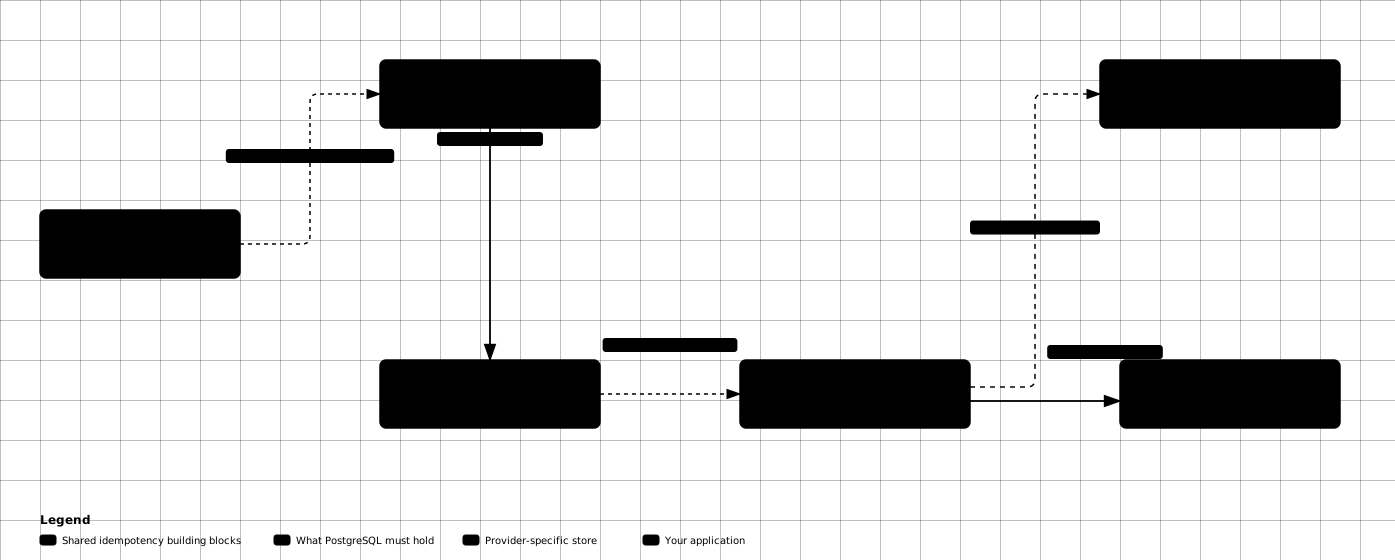
IdempotencyPostgresStore supplies only the Postgres unique-violation check; the reserve → check →
complete flow, the expired-reservation reclaim, and the per-connection-string migration guard all
live in IdempotencyRelationalStore<TContext> — see
DKNet.AspCore.Idempotency.Relational. Its
IdempotencyDbContext and IdempotencyKeyConfiguration override only the two Postgres-specific
bits (text body column, quoted-identifier check-constraint SQL); the rest of the entity mapping
is the relational base’s. The HTTP-facing pieces — endpoint filter, key scope resolution,
IdempotencyOptions — live in DKNet.AspCore.Idempotency.
⚠️ Gotchas & limits
- Migrations run automatically, not on demand:
AddIdempotencyNpgsqlStoreregisters a hosted service (IdempotencyMigrationHostedService<IdempotencyDbContext>) that applies pending migrations once at application startup. There is no separate “apply migrations” step to remember, but also no opt-out. A host that skips or reorders hosted services falls back to the relational base’s per-request guard instead, which checks for and applies pending migrations under a lock the first time the store is used against a given connection string — so the first request against a fresh database pays that cost in that case. - Registration is first-wins.
AddIdempotencyNpgsqlStore/AddIdempotencyWithNpgsqlStorereturn early onceIdempotencyDbContextis registered, andAddIdempotentKey<TStore>returns early once anIIdempotencyKeyStoreis registered — calling either again, even with a different connection string, is silently a no-op. MarkKeyAsProcessedAsyncdefensively swallows a unique violation if it is ever called without a prior reservation (e.g. concurrent calls from a retried background job): it will not throw, but it also will not overwrite whichever caller’s insert won the race — seeIdempotencyMarkAsProcessedConcurrencyTests.- Nothing purges expired rows.
ExpiresAtis indexed and expired rows are reclaimed opportunistically when a request collides with one, but the table grows until you add your own cleanup job for keys that are never retried. - Every protected request costs a database round-trip. For very high-throughput endpoints the Redis store avoids the query planner entirely.
🔗 Related packages
- DKNet.AspCore.Idempotency — the core package this store plugs into; start there to wire idempotency into an app at all.
- DKNet.AspCore.Idempotency.MsSqlStore — the same store shape for SQL Server; reach for it instead when SQL Server, not Postgres, is your database.
- DKNet.AspCore.Idempotency.RedisStore — reach for it when you want the lowest latency and no schema or migrations to own.
- DKNet.AspCore.Idempotency.Relational — read it only if you are adding a new relational provider to the family.