DKNet
DKNet Framework Documentation
DKNet is a suite of independent .NET 10 NuGet packages for building enterprise applications around
Domain-Driven Design and Onion Architecture. There is no framework to adopt wholesale and no single
AddDKNet() call: each package registers itself and can be used on its own, so you pull in only what a given
DbContext, API, or worker actually needs.
28 packages are published to NuGet. One more, Aspire.Hosting.ServiceBus, is source-only in this repository
(<IsPackable>false</IsPackable>) and documented anyway — it is an Aspire shared project you reference from an
AppHost directly. DKNet.EfCore.Repos and DKNet.EfCore.Repos.Abstractions, the older generic-repository
packages, were removed outright; see Migrating-Repos-To-Specifications
if you are upgrading off them.
Quick Navigation
Getting Started
- Getting Started Guide — prerequisites, installation, and a first working setup
- Configuration & Setup — how configuration composes across packages
- Architecture Guide — the rings, what depends on what, and the two end-to-end paths
- Agent skills (
dknet-skills) — install withnpx skills add baoduy/DKNetorclaude plugin install dknet-skills@dknetso your coding agent knows every package
Core Documentation
- API Reference — index into the per-package API documentation
- Examples & Recipes — runnable implementation examples
- FAQ — common questions and troubleshooting
Project Information
- Changelog — version history and release notes
- Migration Guide — upgrading between versions and off retired packages
- Contributing Guide — how to contribute to the project
- Testing Strategy — test stack and coverage targets
- Security Policy — supported versions and vulnerability reporting
Which package do I need?
Sorted by the problem you have, not by namespace. Follow the link for the full API and gotchas.
| I need to… | Package |
|---|---|
| Give entities identity, audit fields, and a domain-event queue | DKNet.EfCore.Abstractions |
Have EF Core discover my IEntityTypeConfiguration<T> classes, apply global filters, seed data, use GUID v7 keys or SQL sequences |
DKNet.EfCore.Extensions |
| Query and persist without hand-rolling a repository per entity | DKNet.EfCore.Specifications |
| Build a search/filter predicate whose criteria are only known at runtime | DKNet.EfCore.Specifications — Dynamic Predicate Builder |
Run my own code before and after every SaveChanges |
DKNet.EfCore.Hooks |
| Let a domain method raise an event that other code reacts to after the write commits | DKNet.EfCore.Events |
| Record who changed which field, with sensitive values redacted | DKNet.EfCore.AuditLogs |
| Stop one tenant or owner from reading another’s rows | DKNet.EfCore.DataAuthorization |
| Encrypt a column without changing the queries that read it | DKNet.EfCore.Encryption |
| Stop hand-writing DTOs that mirror entities | DKNet.EfCore.DtoGenerator |
| Check for or create a table at runtime, whatever the relational provider | DKNet.EfCore.Relational.Helpers |
Separate commands from queries and stop calling SaveChangesAsync in handlers |
DKNet.SlimBus.Extensions |
| Generate CRUD requests, handlers, and endpoints from an attributed entity member | DKNet.SlimBus.Generators |
Map minimal-API endpoint groups by convention and turn a Result into ProblemDetails |
DKNet.AspCore.Extensions |
Make a POST/PUT/PATCH safe for a client to retry |
DKNet.AspCore.Idempotency on its own for local development, plus one store package for deployed traffic |
| Run a job exactly once at start-up, before traffic arrives | DKNet.AspCore.Tasks |
| Store files without binding the application to one cloud | DKNet.Svc.BlobStorage.Abstractions plus one adapter |
| Encrypt, sign, or hash a value in ordinary application code | DKNet.Svc.Encryption |
| Render Markdown or HTML to a PDF file | DKNet.Svc.PdfGenerators |
| Fill bracketed tokens in a template string from an object or a dictionary | DKNet.Svc.Transformation |
| Generate a password, token, or other secret | DKNet.RandomCreator |
Scan assemblies for types, or reach for a string/enum/DateTime/reflection helper |
DKNet.Fw.Extensions |
| Give a local Aspire AppHost its own Azure Service Bus emulator | Aspire.Hosting.ServiceBus (source-only) |
Component Documentation
Core Framework
Foundation utilities that sit at the bottom of the dependency graph and pull in nothing else from DKNet.
- DKNet.Fw.Extensions — framework-agnostic reflection, type, string, enum and DI-inspection helpers, plus fluent assembly/type scanning (
TypeExtractors) - DKNet.RandomCreator — cryptographically secure random string and character generation for passwords, tokens, and other secrets
Entity Framework Core Extensions
Entity base classes, the specification pattern, and the SaveChanges interceptor pipeline everything else hangs off.
- DKNet.EfCore.Abstractions — the persistence-agnostic vocabulary every other
DKNet.EfCore.*package builds on: entity base classes, domain-event contracts, and the attributes that steer audit, sequence, and mapping behaviour - DKNet.EfCore.Extensions — the wiring layer: convention-based entity configuration, global query filters, data seeding, GUID v7 keys, SQL sequences, and the
SnapshotContextthe save hooks are built on - DKNet.EfCore.Specifications — filter, includes, and order-by as one reusable object, executed through a single non-generic
IRepositorySpec, plus a runtime dynamic predicate builder. The current, supported way to query and persist - DKNet.EfCore.Hooks — a pluggable before/after-
SaveChangesinterceptor pipeline: one shared interceptor perDbContexttype plus a pair of interfaces you implement - DKNet.EfCore.Events — dispatches domain events raised by entities during
SaveChanges, so a domain method never references a publisher or a bus - DKNet.EfCore.AuditLogs — captures a structured, field-level change record for every created, updated, or deleted entity and hands the batch to publishers you register
- DKNet.EfCore.DataAuthorization — row-level, ownership-based authorization: an automatic global query filter on reads plus
SaveChanges-time owner stamping on writes - DKNet.EfCore.Encryption — transparent, column-level encryption for
stringproperties, applied at the database boundary via a standardValueConverter - DKNet.EfCore.DtoGenerator — a Roslyn incremental source generator that emits DTO properties from an entity type at compile time
- DKNet.EfCore.Relational.Helpers — four
DbContextextension methods for relational bookkeeping EF Core does not expose: table creation, connection access, table-name resolution, and table-existence checks
Messaging & CQRS
SlimMessageBus integration: CQRS contracts, automatic save, and the CRUD source generator.
- DKNet.SlimBus.Extensions — fluent command/query/event interfaces, automatic
SaveChangesafter a successful write, and domain events forwarded onto the bus - DKNet.SlimBus.Generators — emits a whole CRUD vertical slice (request records, handlers, endpoint registration) from
[CrudCreate]/[CrudUpdate]/[CrudAction]-attributed entity members
Service Layer
Application-level services with no dependency on the EF Core packages.
- DKNet.Svc.BlobStorage.Abstractions — provider-agnostic
IBlobServicecontract and shared model types - DKNet.Svc.BlobStorage.AwsS3 — AWS S3 adapter that also works against S3-compatible services such as MinIO and Cloudflare R2
- DKNet.Svc.BlobStorage.AzureStorage — Azure Blob Storage adapter backed by
Azure.Storage.Blobs - DKNet.Svc.BlobStorage.Local — local-filesystem adapter that stores blobs under a configured root folder with path-traversal protection
- DKNet.Svc.Encryption — explicitly-invoked cryptography: AES-GCM and RSA encryption, RSA signing, HMAC and SHA hashing, and Base64/Base64URL helpers
- DKNet.Svc.PdfGenerators — converts HTML or Markdown into a PDF using headless Chromium (PuppeteerSharp) and Markdig, with page layout, header/footer, and margin control
- DKNet.Svc.Transformation — fills bracketed tokens in a template string from plain objects or string dictionaries by reflection
ASP.NET Core Utilities
Start-up orchestration, minimal-API glue, and idempotency for web and API workloads.
- DKNet.AspCore.Extensions — host-populated request members, discovered and versioned endpoint groups, verb-to-command mappers, generic list/read/delete endpoints, and
FluentResults-to-IResultconversion - DKNet.AspCore.Tasks — implement
IBackgroundTask, register it, and oneBackgroundServiceruns every registered task once when the host starts - DKNet.AspCore.Idempotency — an
IEndpointFilterthat recognises a client-supplied idempotency key, blocks the same operation from running twice, and replays or rejects the retry - DKNet.AspCore.Idempotency.MsSqlStore — SQL Server-backed key store
- DKNet.AspCore.Idempotency.NpgsqlStore — PostgreSQL-backed key store
- DKNet.AspCore.Idempotency.RedisStore — Redis-backed key store using
SET NXreservation and native key expiry, with no schema or migrations - DKNet.AspCore.Idempotency.Relational — the shared EF Core building blocks the two relational stores derive from. Not referenced directly by application code
Aspire Integrations
Infrastructure orchestration helpers for .NET Aspire AppHost projects.
- Aspire.Hosting.ServiceBus — adds the Azure Service Bus emulator as a resource inside an Aspire AppHost, so local work needs no shared cloud namespace. Source-only: it sets
<IsPackable>false</IsPackable>, so reference the project from your AppHost rather than a NuGet package
Architecture Overview
Every ring of the onion is a separate package, and every dependency points inward. The Architecture Guide walks the same picture in detail, adds the package dependency graph, and traces a request and a domain event end to end.
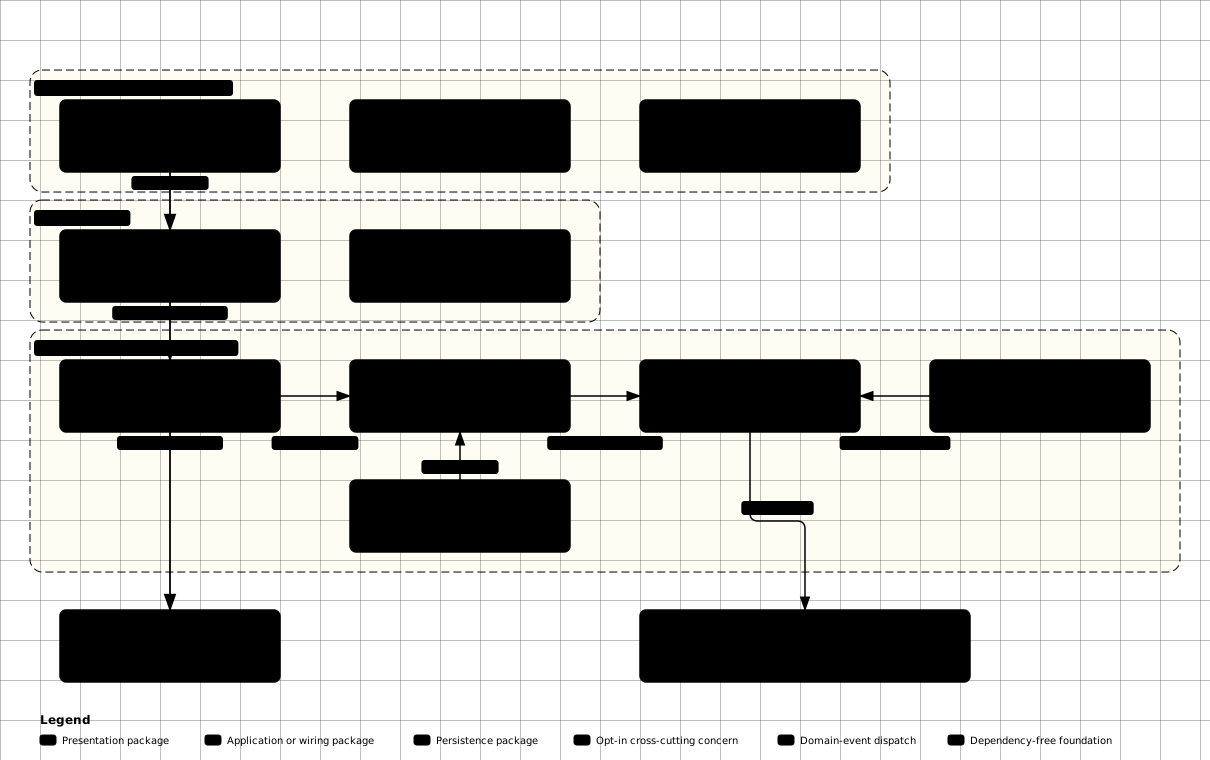
Key architectural principles
- Dependency inversion — inner rings never reference outer ones; the arrows above are real
ProjectReferenceentries insrc/. - Separation of concerns — one package, one responsibility, and no package that only exists to aggregate others.
- Domain-centricity — business rules live in entity methods;
DKNet.EfCore.Abstractionsis the only package a domain model has to see. - Event-driven where it helps — domain events are queued on the entity and dispatched after the write commits, so a domain method never talks to a bus.
- Specifications, not a repository per entity — one injected
IRepositorySpecserves every entity type; the entity comes from the specification passed to each call.
Getting started
- Pick the packages you need — start from the Which package do I need? table above.
- Read the ring it lives in — the Architecture Guide explains what a package can and cannot depend on.
- Wire it up — Configuration & Setup covers the four registration conventions the packages share.
- Copy a working example — Examples & Recipes, or the SlimBus.ApiEndpoints template in the DKNet.Templates repository.
Contributing to documentation
Corrections and additions are welcome. Open an issue describing the problem, or send a pull request that follows the structure and voice of the surrounding pages — the canonical page structure is the Package Documentation Template; see also the Contributing Guide.
Every claim on these pages should be traceable to src/, a test, or a config file. If you find one that
is not, that is a bug worth reporting in the DKNet repository.