DKNet
DKNet.Svc.Transformation
Fills bracketed tokens in a template string — [Name], {Email}, <Amount>, {{Ref}} — from plain objects or string dictionaries, formatting each resolved value on the way in.
✨ Why use it?
- No
string.Replacechains. OneTransform(template, data)call resolves every token in the template against the objects you pass, in order. - The data source can be whatever you already have. A DTO, an anonymous object, or a collection of objects — property lookup is case-insensitive. An
IDictionary<string, string>is looked up by key only when passed directly toTransform/TransformAsync, not inside a collection or inGlobalParameters. - Values are formatted, not just stringified. Numbers, dates, and booleans go through a pluggable
IValueFormatter, sotruerenders asYesand1234.5as1,234.50without per-call formatting code. - Your template’s brackets, not the library’s. Square brackets by default; curly, angled, double-curly, or a custom pair are one option away.
🚀 Quick Start
Use a .NET 10 console project. Install the package, then replace Program.cs with the example.
dotnet new console -f net10.0 -n TransformDemo
cd TransformDemo
dotnet add package DKNet.Svc.Transformation
dotnet add package Microsoft.Extensions.DependencyInjection
using Microsoft.Extensions.DependencyInjection;
using DKNet.Svc.Transformation;

var services = new ServiceCollection();
services.AddTransformerService(); // ITransformerService, transient
var provider = services.BuildServiceProvider();

var transformer = provider.GetRequiredService<ITransformerService>();
var order = new { OrderId = 4711, Total = 129.5m };
Console.WriteLine(transformer.Transform("Order [OrderId] — [Total]", order));
// Order 4,711 — 129.50
Run with dotnet run.
🏗️ Architecture
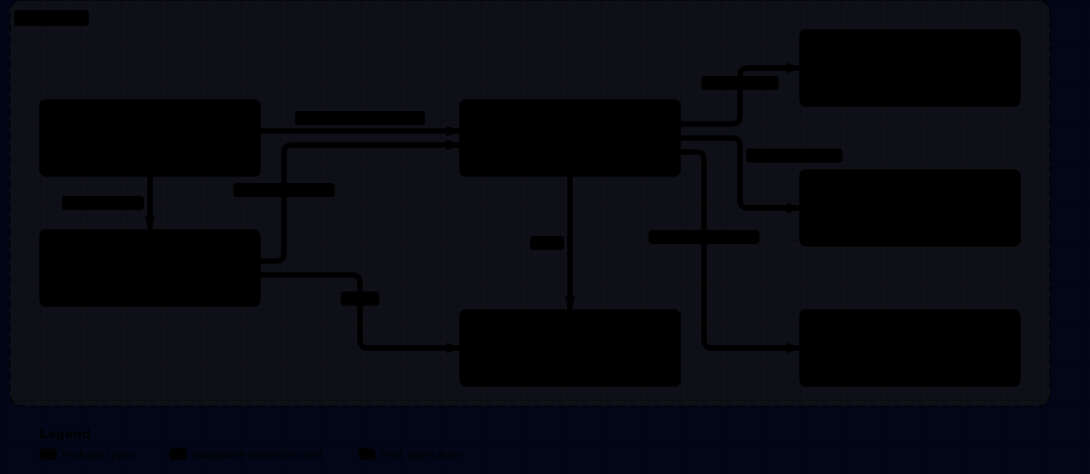
AddTransformerService returns immediately if ITransformerService is already registered, so only the first call’s options take effect. TransformerService is transient, TransformOptions is held as a singleton IOptions<TransformOptions>. This does not show request scoping in the host app, or that TokenExtractor/TokenResolver are internal types the service builds for itself.
🔄 How it works

Transform runs extraction, resolution, formatting, and rebuilding synchronously; TransformAsync differs only in that extraction runs on the thread pool — resolution itself is always synchronous reflection. This does not show the per-call token cache (one dictionary created fresh inside each Transform/TransformAsync call, so a token repeated in the same template resolves once and nothing ever leaks between calls), or that the default TokenNotFoundBehavior is ThrowError.
🧩 Features
- Fill a template from objects or dictionaries — resolve tokens against the call’s own parameters, then
GlobalParameters, with the not-found policy for what cannot be resolved. - Choose token syntax — pick built-in bracket styles or define a custom token pair.
- Format resolved values — control how bool/number/date values become display text.
- Register the service — wire up
AddTransformerServiceand configureGlobalParameters.
🔗 Related packages
- DKNet.Svc.PdfGenerators — fill a Markdown or HTML template here, then convert the filled result to PDF.
- DKNet.Svc.BlobStorage.Abstractions — store the rendered output, or read the template itself out of blob storage before transforming it.
- DKNet.Fw.Extensions — reach for it for the general-purpose string, type, and reflection helpers used across DKNet.