DKNet
DKNet.SlimBus.Extensions
CQRS and messaging glue on top of SlimMessageBus — fluent command, query
and event-consumer contracts, FluentResults-based handlers, lazy Mapster mapping, and an opt-in EF Core auto-save
and domain-event publisher for hosts that use a DbContext.
✨ Why use it?
- Request shape says what a message is. Implementing
Fluents.Requests.*marks a write,Fluents.Queries.*marks a read — no attributes, no naming conventions to remember. - Expected business failures are results, not exceptions. Commands return
FluentResultstypes, so “product not found” is a value the caller inspects rather than a thrown exception to catch. - EF Core writes without a
SaveChangesAsynccall.AddSlimBusEfCoreInterceptor<TDbContext>()saves theDbContextfor you after a successful write, andAddSlimBusEventPublisher<TDbContext>()forwards the domain events that save raised onto the bus. - No bundled transport. There is no one-call setup for the bus itself — you call SlimMessageBus’s own
AddSlimMessageBus(...)and pick the provider (memory, Azure Service Bus, Kafka) yourself; theFluentscontracts and your handlers stay the same either way.
This package already depends on EF Core: it references X.PagedList.EF (paged query results) and
DKNet.EfCore.Events (the domain-event publisher). If your handlers never touch a DbContext, you can still install
it and simply not call the two EF Core registration methods.
🚀 Quick Start
Use a .NET 10 console project. Install the packages, then replace Program.cs with the example.
dotnet new console -f net10.0 -n SlimBusDemo
cd SlimBusDemo
dotnet add package DKNet.SlimBus.Extensions
dotnet add package SlimMessageBus.Host.Memory --version 3.5.0
using DKNet.SlimBus.Extensions;
using FluentResults;
using Microsoft.Extensions.DependencyInjection;
using SlimMessageBus;
using SlimMessageBus.Host;
using SlimMessageBus.Host.Memory;

var services = new ServiceCollection();
services.AddLogging();
services.AddSlimMessageBus(mbb => mbb
    .AddServicesFromAssembly(typeof(Program).Assembly)
    .AddChildBus("Memory", m => m
        .WithProviderMemory()
        .AutoDeclareFrom(typeof(Program).Assembly)));

await using var provider = services.BuildServiceProvider();
var bus = provider.GetRequiredService<IMessageBus>();

var result = await bus.Send(new Ping("hello"));
Console.WriteLine(result.IsSuccess ? result.Value : "failed");

public record Ping(string Text) : Fluents.Requests.IWitResponse<string>;

internal sealed class PingHandler : Fluents.Requests.IHandler<Ping, string>
{
    public Task<IResult<string>> OnHandle(Ping request, CancellationToken cancellationToken) =>
        Task.FromResult<IResult<string>>(Result.Ok($"pong: {request.Text}"));
}
Run with dotnet run. Prints pong: hello.
The package brings no transport of its own — SlimMessageBus.Host.Memory above is the in-process provider for local
development and tests. For a real deployment, swap it for the Azure Service Bus, Kafka, or another SlimMessageBus
provider package and pass it to the same AddChildBus(...) call; the Fluents contracts and your handlers never
change. No serializer is needed for the memory provider. AutoDeclareFrom declares the message types on that child
bus — leaving it out makes Send return null without ever reaching your handler. AddServicesFromAssembly
registers your handler types in DI. Both come from SlimMessageBus’s own SlimMessageBus.Host /
SlimMessageBus.Host.Memory packages, not from this one.
🏗️ Architecture
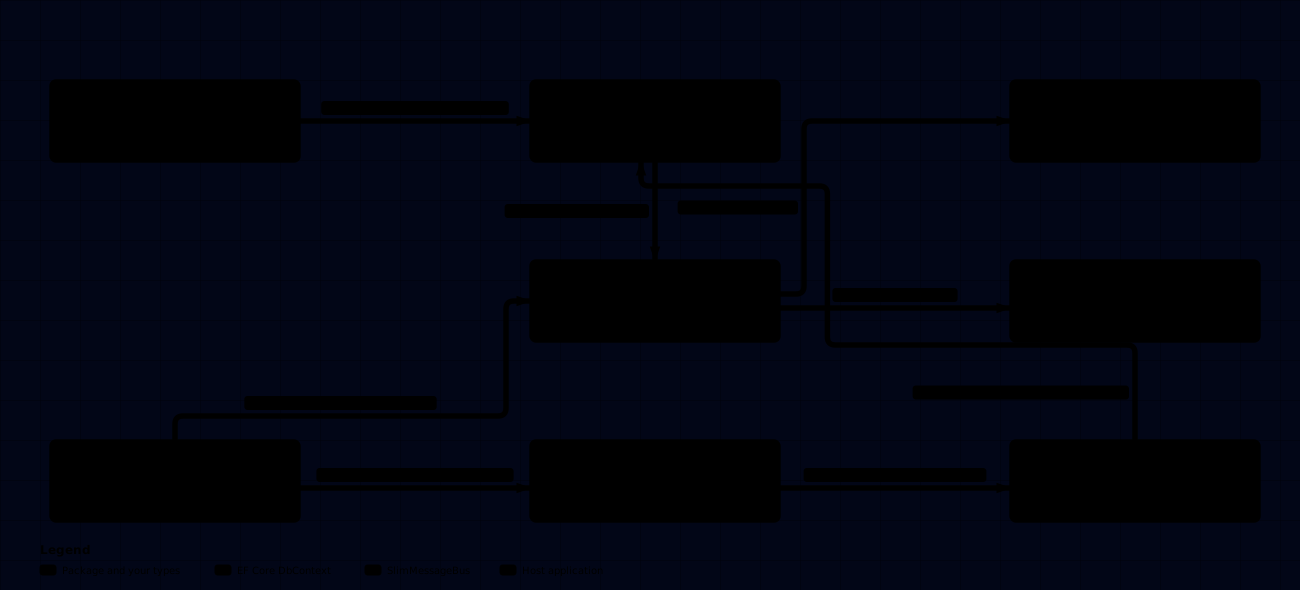
The top row — IMessageBus, the Fluents contracts, your handlers, and LazyMapper — needs no DbContext. The
bottom row is opt-in: nothing wires it up unless the host calls
AddSlimBusEfCoreInterceptor<TDbContext>() and/or AddSlimBusEventPublisher<TDbContext>(). The diagram cannot show
registration order or DI lifetimes; see Auto-save after a successful write and
Publish domain events onto the bus for those.
🔄 How it works

This is the write path with both EF Core add-ons registered — the pipeline a plain Fluents.Requests write handler
sees once the host calls AddSlimBusEfCoreInterceptor<TDbContext>() and AddSlimBusEventPublisher<TDbContext>().
Without those two calls, Send goes straight from your interceptors to the handler and back, with no save and no
event publish. A query (Fluents.Queries.*) never enters the auto-save branch at all, whatever it leaves in the
change tracker — see Run read queries.
🧩 Features
- Send write commands — Declare requests with
Fluents.Requests.INoResponse/IWitResponse<T>and implement their handlers. - Run read queries — Declare queries with
Fluents.Queries.IWitResponse<T>/IWitPageResponse<T>and implement their handlers. - Consume published events — Implement
Fluents.EventsConsumers.IHandler<TEvent>to react to a message on the bus. - Auto-save after a successful write — Register
AddSlimBusEfCoreInterceptor<TDbContext>()so a successful write saves theDbContextfor you. - Publish domain events onto the bus — Register
AddSlimBusEventPublisher<TDbContext>()so events raised byDKNet.EfCore.EventsreachIMessageBus. - Map results lazily — Defer a Mapster mapping until a handler’s result value is actually
read, with
ILazyMap<T>andIMapper.ResultOf<T>.
🔗 Related packages
- DKNet.SlimBus.Generators — reach for it to generate CRUD requests,
handlers, and endpoints built on these same
Fluentsinterfaces instead of hand-writing them. - DKNet.AspCore.Extensions — reach for it to map
Fluentsrequests to minimal-API endpoints and turn their results into HTTP responses. - DKNet.EfCore.Events — the source of the domain events
AddSlimBusEventPublisher<TDbContext>()forwards onto the bus. - DKNet.EfCore.Extensions — supplies
AddNewEntitiesFromNavigationsandSaveChangesWithConcurrencyHandlingAsync, the save primitives the auto-save interceptor calls. - DKNet.EfCore.Hooks — owns
AddDbContextWithHook<TDbContext>(), the save-hook pipeline that domain-event publishing depends on. - DKNet.EfCore.Specifications — reach for it (and its
X.PagedList.EFdependency) to build the paged, specification-driven queries aFluents.Queries.IPageHandler<,>returns.