DKNet
DKNet.EfCore.Abstractions
Entity identities, event contracts and policy attributes for .NET developers modelling a domain without the EF Core runtime.
✨ Why use it?
- Give domain entities a consistent identity and event queue without depending on a transport.
- Declare audit, sequence, CRUD and sensitivity policy next to the model while keeping enforcement in infrastructure.
- Share audit, concurrency and soft-delete contracts across the DKNet persistence packages.
🚀 Quick Start
Use a .NET 10 console project. Install the package, then replace Program.cs with the example.
dotnet new console -f net10.0 -n EfCoreDemo
cd EfCoreDemo
dotnet add package DKNet.EfCore.Abstractions
using DKNet.EfCore.Abstractions.Entities;
using DKNet.EfCore.Abstractions.Events;

var order = new Order();
order.Place();
Console.WriteLine(order.GetEvents().Events.Length); // 1
order.ClearEvents();
Console.WriteLine(order.GetEvents().Events.Length); // 0

public sealed class Order : Entity
{
    public void Place() => AddEvent(new OrderPlaced(Id));
}
public sealed record OrderPlaced(Guid OrderId) : EventItem;
Run with dotnet run.
🏗️ Architecture
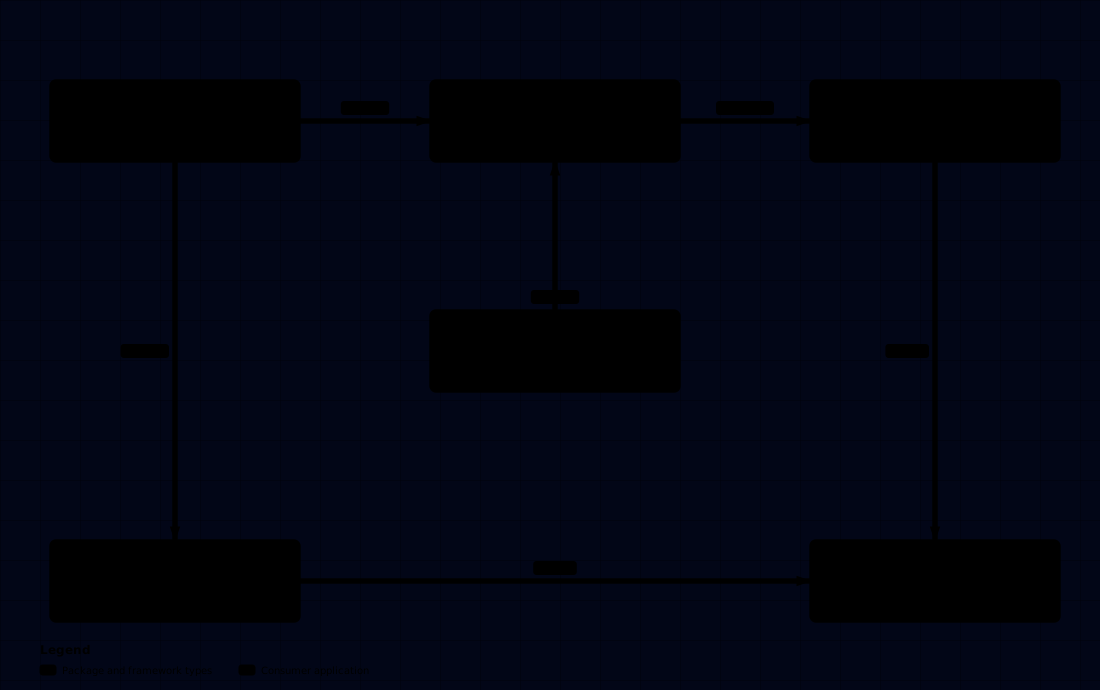
Abstractions has no service registration or background work. Entity queues belong to each entity; attributes and interfaces are consumed by the host runtime packages. Direct references are EF Core Abstractions, annotations and FluentResults, rather than the EF Core runtime.
🔄 How it works

The Quick Start only exercises the in-memory queue. It does not publish or persist anything; use Events and Hooks for dispatch around SaveChangesAsync.
🧩 Features
- Give domain entities an identity — Use
Entity<TKey>for an identity plus event queues, or implement the covariantIEntity<out TKey>contract yourself. - Record who created and changed an entity — Derive from
AuditedEntity<TKey>or its Guid specialization to store audit identity and timestamps. - Expose an optimistic concurrency token — Implement
IConcurrencyEntity<TType>to give infrastructure a consistentRowVersionproperty and setter. - Represent a soft deletion in the domain — Implement
ISoftDeletableEntitywhen deletion records a flag, user and time instead of removing the object. - Queue domain events without choosing a transport —
Entity<TKey>implementsIEventEntitywith separate queues for event objects and event types. - Declare events for persistence operations — Apply repeatable, non-inherited
[RaisesEvent]declarations to an entity for create, update or delete payloads. - Describe database sequences with enum metadata — Put
[SqlSequence]on an enum and[Sequence]on each member that represents a database sequence. - Declare audit capture and sensitive properties — Attach policy markers to the domain model and let the appropriate runtime consumer enforce them.
- Mark domain members for CRUD generation — Declare which constructors and methods SlimBus.Generators can turn into request handlers and endpoints.
🔗 Related packages
- DKNet.EfCore.Extensions — reach for it to configure domain contracts in the EF model.
- DKNet.EfCore.Events — reach for it to publish queued or declared domain events.
- DKNet.EfCore.Hooks — reach for it to write a custom save hook.
- DKNet.EfCore.AuditLogs — reach for it for field-level audit capture.
- DKNet.EfCore.DtoGenerator — reach for it to generate and validate declared event payloads.