DKNet
DKNet.Svc.Encryption
Explicitly-invoked cryptography toolkit for application code — AES-GCM and RSA encryption, RSA signing, HMAC and SHA hashing, and Base64/Base64URL helpers, all string-in/string-out.
[!NOTE] Looking for transparent EF Core column encryption instead — where an attribute on an entity property does the work automatically on save/load? That’s a different package:
DKNet.EfCore.Encryption. UseDKNet.Svc.Encryptionwhen you want to callEncrypt/Decryptyourself; useDKNet.EfCore.Encryptionwhen you want a column encrypted without touching the code that reads and writes the entity. The two don’t share implementation —DKNet.EfCore.Encryption’s AES-GCM provider has its own key-provider abstraction.
✨ Why use it?
- Authenticated encryption without the ceremony.
IAesGcmEncryptionhandles nonce generation, tag handling, and packaging into a single Base64 string, so call sites never assemble a cipher envelope by hand. - Correct-by-default primitives. Fresh random nonce per call, OAEP-SHA256 for RSA, constant-time comparison on every
Verify*and on the AES-GCMbase64Keyoverloads’ key check — the choices that are easy to get wrong are already made. - UTF-8 strings in, Base64 strings out. Values fit straight into JSON payloads, configuration, headers, or a
varcharcolumn with no byte-array plumbing. - Nothing else comes with it. No EF Core, no hosting, no storage dependency — usable from a domain service, a console app, or a background worker.
Reach for it whenever application code needs to encrypt a value, hash a token, sign a webhook payload, or verify an HMAC — anywhere the call site should control exactly when encryption happens.
🚀 Quick Start
dotnet add package DKNet.Svc.Encryption
using DKNet.Svc.Encryption;

// IShaHashing and IHmacHashing — the keyless hashing services, transient
builder.Services.AddEncryptionServices();

// Every cipher is opt-in and takes the key you supply — one singleton per key
builder.Services.AddAesGcmEncryption(builder.Configuration["Crypto:AesKey"]!);
builder.Services.AddRsaEncryption(builder.Configuration["Crypto:RsaPrivateKey"]!);
public sealed class SecretStore(IAesGcmEncryption aesGcm)
{
    public string Protect(string plainText) => aesGcm.EncryptString(plainText);
    public string Reveal(string cipherPackage) => aesGcm.DecryptString(cipherPackage);
}
AddEncryptionServices registers no cipher — only the hashing services. Each cipher has its own key-taking
registration: AddAesGcmEncryption and AddRsaEncryption. All three methods are idempotent — calling any of them
twice does not double-register — and the two cipher methods throw ArgumentException for a null, empty, or
whitespace key.
[!IMPORTANT] A cipher’s key is yours to supply and persist.
AddAesGcmEncryption(base64Key)registersIAesGcmEncryptionas a singleton built from that key, so every resolution shares it and a value encrypted in one request is decryptable in the next. Source the key from configuration or a key vault — never hardcode it.new AesGcmEncryption()with no key still generates a random one, which is fine only for data that never outlives the process.
🧩 Features
AES-GCM (IAesGcmEncryption) — the encryption to reach for
string EncryptString(string plainText, byte[]? associatedData = null);
string DecryptString(string cipherPackage, byte[]? associatedData = null);
string Encrypt(string plainText, string base64Key, byte[]? associatedData = null);
string Decrypt(string cipherPackage, string base64Key, byte[]? associatedData = null);
string Key { get; } // Base64, persist this to decrypt later
new AesGcmEncryption() generates a random 256-bit key; new AesGcmEncryption(existingBase64Key) reconstructs an
instance from a previously persisted key (accepting 128/192/256-bit keys, and rejecting a key containing : — that
shape belonged to the removed AES-CBC type’s key:iv format). Every call produces a fresh random 12-byte nonce and
16-byte tag, so ciphertext is never deterministic even for the same plaintext:
using var aes = new AesGcmEncryption();          // keep aes.Key to decrypt later
var package = aes.EncryptString("4111-1111-1111-1111");
var plain = aes.DecryptString(package);
The returned package is Base64 of nonce:tag:cipher (each part itself Base64) — treat it as opaque and pass it around
whole. Pass associatedData (AAD) when tamper detection should cover context outside the ciphertext; decrypting with
different AAD throws CryptographicException. The Encrypt/Decrypt overloads that take a base64Key throw
InvalidOperationException when it does not match the instance’s own key — they never silently re-key. The
comparison decodes both keys and runs CryptographicOperations.FixedTimeEquals on the resulting bytes, so a wrong
key takes the same time to reject no matter how much of it happened to be right, and a base64 string that decodes
to the same bytes as the instance’s own key is accepted even if the two strings differ textually.
RSA (IRsaEncryption) — asymmetric encrypt and sign
new RsaEncryption(int keySize = 2048);               // generates a new key pair
new RsaEncryption(string privateKeyBase64);          // loads an existing private key (PKCS#1 DER, Base64)
RsaEncryption.FromPublicKey(string publicKeyBase64); // public-only instance

string Encrypt(string plainText);   // OAEP-SHA256
string Decrypt(string base64CipherText);
string Sign(string data);           // PKCS#1 v1.5 + SHA256
bool Verify(string data, string base64Signature);
string PublicKey { get; }
string? PrivateKey { get; }         // null on a public-only instance
A public-only instance can Encrypt and Verify but throws InvalidOperationException on Decrypt/Sign — deploy it
on the side that only sends or verifies, and keep the private key off that side entirely:
// signing side (has the private key)
using var signer = new RsaEncryption(privateKeyBase64);
var signature = signer.Sign(payload);

// verifying side (public key only)
using var verifier = RsaEncryption.FromPublicKey(publicKeyBase64);
var ok = verifier.Verify(payload, signature);
PublicKey and PrivateKey are Base64 of the raw PKCS#1 structures (ExportRSAPublicKey / ExportRSAPrivateKey) —
not PEM, so don’t paste them into a -----BEGIN block without re-encoding.
HMAC signatures (IHmacHashing)
string ComputeSha256(string message, string secretKey, bool asBase64 = true);
string ComputeSha512(string message, string secretKey, bool asBase64 = true);
bool VerifySha256(string message, string secretKey, string expectedSignature, bool signatureIsBase64 = true);
bool VerifySha512(string message, string secretKey, string expectedSignature, bool signatureIsBase64 = true);
Set asBase64 = false to get upper-case hex instead, and match that choice with signatureIsBase64 on the verify call —
a mismatched encoding returns false rather than throwing. The key bytes are zeroed after each computation, and
comparison runs through CryptographicOperations.FixedTimeEquals:
// verifying an inbound webhook signature
var trusted = hmac.VerifySha256(rawBody, webhookSecret, header["X-Signature"]!);
Blank message, secretKey, or expectedSignature throws ArgumentException.
Content hashes (IShaHashing)
string ComputeSha256(string input, bool upperCase = false);
string ComputeSha512(string input, bool upperCase = false);
bool VerifySha256(string input, string expectedHex, bool ignoreCase = true);
bool VerifySha512(string input, string expectedHex, bool ignoreCase = true);
Output is hex, lower-case unless upperCase is set. Verification is hex-only (expectedHex), constant-time, and returns
false — instead of throwing — when the expected value isn’t valid hex. Empty string input is allowed; null throws.
Base64 / Base64URL helpers
Base64StringExtensions exposes ToBase64String, FromBase64String, ToBase64UrlString, FromBase64UrlString, and
IsBase64String as this string extension methods, so both call styles work:
using DKNet.Svc.Encryption;

var token = payloadJson.ToBase64UrlString();          // extension-method call
var back = Base64StringExtensions.FromBase64UrlString(token); // static call — still compiles
The URL variants are useful for JWT-style payloads without pulling in a JWT library. Whitespace or empty input
returns string.Empty from both decode helpers, and IsBase64String returns false for it.
AES-CBC (IAesEncryption) — removed
IAesEncryption, AesEncryption, and EncryptionSetup.AddAesEncryption have been removed, not merely
deprecated. AES-CBC as this type used it kept a fixed IV embedded in the key, so encrypting the same plaintext twice
always produced the same ciphertext — a real leak of information about the data (e.g. two customers sharing a
password hash, or a repeated field, becomes visible from ciphertext alone) rather than a theoretical concern.
IAesGcmEncryption (AddAesGcmEncryption) is authenticated, uses a fresh random nonce per call, and is the only
symmetric cipher this package ships. There is no compatibility shim — code still calling AddAesEncryption or
constructing AesEncryption will not build; re-encrypt existing ciphertext under IAesGcmEncryption and switch the
call sites.
⚙️ Configuration reference
There is no options type and no IConfiguration binding path in this package. The entire customisation
surface is the four registration methods and the constructors behind them — everything a caller can vary
is an argument, so this table is the equivalent of a configuration reference.
Registration surface (EncryptionSetup)
| Method | Argument | Registers | Lifetime | Throws |
|---|---|---|---|---|
AddEncryptionServices() |
— | IShaHashing, IHmacHashing |
Transient | — |
AddAesGcmEncryption(base64Key) |
Base64 128/192/256-bit key | IAesGcmEncryption |
Singleton | ArgumentException on a blank key |
AddRsaEncryption(privateKeyBase64) |
Base64 PKCS#1 private key | IRsaEncryption |
Singleton | ArgumentException on a blank key |
All three skip registration when the service type is already registered, so a second call is a no-op rather than a second instance — the first call’s key is the one the application uses.
Constructor surface (when you build an instance yourself)
| Constructor / factory | Parameter | Default | Effect |
|---|---|---|---|
new AesGcmEncryption(string? key = null) |
Base64 key, no : |
null |
null generates a random 256-bit key; a supplied key must decode to 16, 24, or 32 bytes. |
new RsaEncryption(int keySize = 2048) |
Key size in bits | 2048 |
Generates a fresh key pair at that size. |
new RsaEncryption(string privateKeyBase64) |
PKCS#1 private key | (required) | Loads an existing pair; the public key is derived. |
RsaEncryption.FromPublicKey(string publicKeyBase64) |
PKCS#1 public key | (required) | Public-only instance: Encrypt/Verify work, Decrypt/Sign throw. |
Per-call switches
| Member | Parameter | Default | Effect |
|---|---|---|---|
IAesGcmEncryption.EncryptString / DecryptString |
associatedData |
null |
Extra bytes bound into the authentication tag; a mismatch on decrypt throws CryptographicException. |
IHmacHashing.ComputeSha256 / ComputeSha512 |
asBase64 |
true |
false returns upper-case hex instead of Base64. |
IHmacHashing.VerifySha256 / VerifySha512 |
signatureIsBase64 |
true |
Must match how the signature was produced; a mismatch returns false. |
IShaHashing.VerifySha256 / VerifySha512 |
ignoreCase |
true |
No effect — comparison runs on decoded bytes. (IHmacHashing’s Verify* overloads dropped this parameter entirely; it was never read.) |
IShaHashing.ComputeSha256 / ComputeSha512 |
upperCase |
false |
true returns upper-case hex. |
Fixed algorithm choices
These are not configurable and are worth knowing before you design around them:
| Concern | Value |
|---|---|
| AES-GCM nonce / tag | 12 bytes / 16 bytes, fresh nonce per call |
| AES-GCM generated key size | 256-bit |
| AES-GCM package layout | Base64 of base64(nonce):base64(tag):base64(cipher) |
| RSA encryption padding | OAEP-SHA256 |
| RSA signature | SHA-256 with PKCS#1 v1.5 |
| Key export format | Raw PKCS#1 DER, Base64 — not PEM |
| Verification comparison | CryptographicOperations.FixedTimeEquals — also used for the AES-GCM base64Key overloads’ key check |
🧱 Where it fits
Which registration you call decides which service you can resolve — and only the cipher registrations take a key:
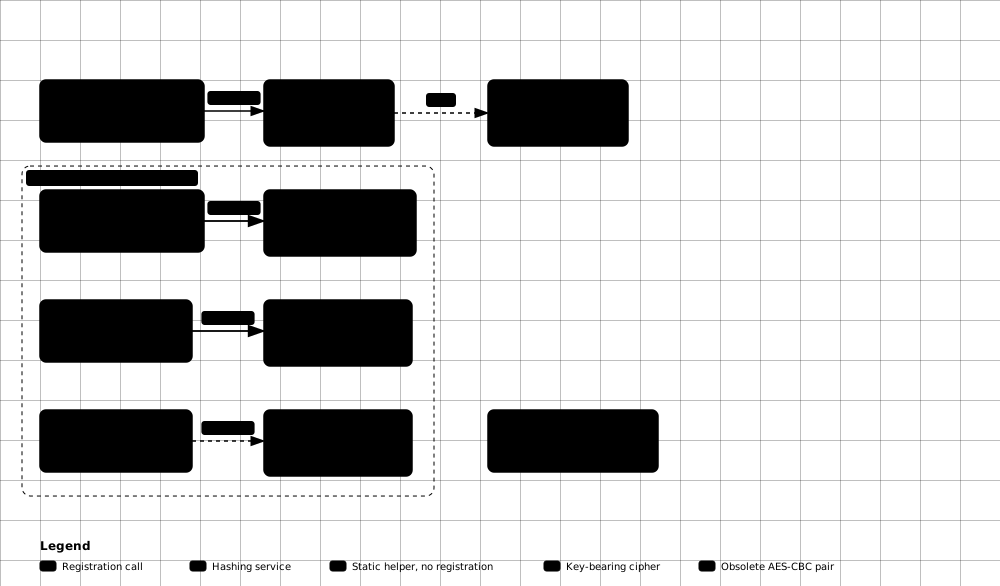
- DKNet.EfCore.Encryption — the transparent counterpart: encrypt a column without the calling code knowing. Use this package when the call site should decide; use that one when the storage layer should.
- DKNet.Svc.BlobStorage.Abstractions — encrypt a payload here before
handing the bytes to
SaveAsyncwhen the store itself must never see plaintext. - The rest of DKNet — this package depends on nothing beyond
Microsoft.Extensions.DependencyInjection.Abstractions, so it can be called from a domain service, a handler, or a hosted worker without pulling in EF Core or messaging.
⚠️ Gotchas & limits
- Cipher registrations are singletons over the key you passed in. One
AddAesGcmEncryptioncall means one key for the whole application; rotating it means new configuration and a restart. A hand-builtnew AesGcmEncryption()generates a throwaway key instead, so ciphertext produced from it dies with the instance. - No password-based key derivation. To encrypt with a user-supplied password, derive a key yourself (e.g.
Rfc2898DeriveBytes) before constructingAesGcmEncryption. An earlier revision of this page documented aPasswordAesEncryptiontype; it does not exist in source. ignoreCaseonIShaHashing.Verify*is a no-op. Comparison is done on decoded bytes, so case never matters — don’t read the parameter as a behavior switch.IHmacHashing.Verify*doesn’t have the parameter at all.IShaHashingandIHmacHashingare notIDisposable. Both are stateless wrappers over the staticSystem.Security.Cryptographyhash APIs — nousingneeded, unlikeIAesGcmEncryption/IRsaEncryptionbelow.Key,PrivateKey, andPublicKeyare yours to persist and rotate. The package stores nothing and has no key rotation, versioning, or envelope-key support.- String-only surface. No stream, file, or
byte[]overloads — a large payload is fully materialized as a UTF-8 string and again as Base64. - AES-GCM instances serialize their crypto calls.
Encrypt/Decrypttake a lock on the sharedAesGcmhandle, so one instance is thread-safe but not concurrent; resolve per unit of work if throughput matters. - Dispose what you construct.
AesGcmEncryptionandRsaEncryptionhold native handles; DI disposes the transient and singleton registrations, but a hand-built instance needs ausing.
🔗 Related packages
- DKNet.EfCore.Encryption – reach for it when a column should be encrypted transparently on save and decrypted on load.
- DKNet.Svc.BlobStorage.Abstractions – reach for it when the values being protected are files rather than fields.
- DKNet.Svc.Transformation – reach for it when a template’s tokens must be resolved before the result is encrypted or signed.