DKNet
DKNet.EfCore.AuditLogs
A SaveChanges interceptor that captures a structured, field-level change record for every created, updated, or
deleted entity, and hands the batch to publishers you register.
✨ Why use it?
- No hand-rolled
ChangeTrackerwalk — the hook enumerates everyAdded/Modified/Deletedentry and diffs its mapped scalar properties for you, instead of that loop being copy-pasted into eachDbContext. - Sensitive values are redacted by default — property names matching a built-in deny-list (
password,token,apikey,ssn,creditcard, …) and anySecureStringproperty are captured as"***REDACTED***", so an audit trail cannot silently become a credential leak. A property carrying an[Encrypted](DKNet.EfCore.Encryption.Attributes.EncryptedAttribute) attribute is redacted the same way, unconditionally. - Declarative opt-in and opt-out —
[AuditLog],[IgnoreAuditLog], and[SensitiveData]on the entity decide what is captured, so the policy lives next to the model rather than in audit plumbing. - The audit identity is your application’s, not the tenant’s — register an
ICurrentUserProviderand the same hook stampsCreatedBy/UpdatedByfrom the signed-in user before it captures the entry, so the saved row and its audit record always agree on who made the change. - You own the sink — the package produces
AuditLogEntryrecords and calls yourIAuditLogPublisher; where they land (table, queue, log sink) is your decision, keyed perDbContexttype. - Shares one pipeline with the other hook packages — auditing, domain events, and data authorization all run in the same before/after-save pass from DKNet.EfCore.Hooks, not in three competing interceptors.
Reach for this package when you need an automatic audit trail of entity changes and are willing to plug in your own
storage. If you only need EF Core’s change-tracking debug view for troubleshooting, use
DbContext.ChangeTracker.DebugView; if you need to protect the value at rest rather than log its history, use
DKNet.EfCore.Encryption.
🚀 Quick Start
dotnet add package DKNet.EfCore.AuditLogs
The package depends on DKNet.EfCore.Abstractions (for IAuditedProperties and the [AuditLog]/[IgnoreAuditLog]/[SensitiveData] attributes) and DKNet.EfCore.Hooks (for the SaveChanges pipeline), plus Microsoft.EntityFrameworkCore.
Registering the hook alone is not enough — the DbContext must also be wired into the hook pipeline via AddDbContextWithHook (or a manual options.UseHooks<TDbContext>(provider) call), exactly as for any other DKNet.EfCore.Hooks consumer:
using DKNet.EfCore.AuditLogs;
using DKNet.EfCore.Hooks;
using Microsoft.Extensions.DependencyInjection;

// 1. Register the DbContext through the hook-aware overload.
services.AddDbContextWithHook<AppDbContext>((provider, options) =>
    options.UseSqlServer(connectionString));

// 2. Register the audit hook plus a publisher, keyed to AppDbContext.
services.AddEfCoreAuditLogs<AppDbContext, MyAuditLogPublisher>();

// 3. Optional: fill CreatedBy/UpdatedBy from the signed-in user instead of leaving them to
//    DKNet.EfCore.DataAuthorization's ownership key.
services.AddCurrentUserProvider<AppDbContext, SignedInUserProvider>();
AddEfCoreAuditLogs<TDbContext, TPublisher>() is the one-call setup: it registers TPublisher as a keyed IAuditLogPublisher (keyed by typeof(TDbContext).FullName) and internally calls AddEfCoreAuditHook<TDbContext>(), which registers the AuditLogOptions and adds EfCoreAuditHook via services.AddHook<TDbContext, EfCoreAuditHook>(). If you want the hook without a publisher yet (e.g. registering publishers separately, or several of them), call AddEfCoreAuditHook<TDbContext>() directly and add publishers with services.AddKeyedScoped<IAuditLogPublisher, TPublisher>(typeof(TDbContext).FullName!).
Step 3 is independent of the other two: AddCurrentUserProvider<TDbContext, TProvider>() attaches the audit hook itself, so it works on its own when you only want CreatedBy/UpdatedBy filled and no audit trail published — see ICurrentUserProvider.
🧩 Features
AuditLogEntry — the captured record shape
Every audited operation produces one AuditLogEntry (a sealed record implementing IAuditedProperties from Abstractions):
public sealed record AuditLogEntry : IAuditedProperties
{
    public required AuditLogAction Action { get; init; }       // Created | Updated | Deleted
    public required DateTimeOffset CreatedOn { get; init; }
    public DateTimeOffset? UpdatedOn { get; init; }
    public required IDictionary<string, object?> Keys { get; init; }        // primary-key name -> value
    public required IReadOnlyList<AuditFieldChange> Changes { get; init; }  // field-level diffs
    public required string CreatedBy { get; init; }
    public required string EntityName { get; init; }            // entry.Entity.GetType().Name
    public string? UpdatedBy { get; init; }
}

public sealed record AuditFieldChange
{
    public required string FieldName { get; init; }
    public object? OldValue { get; init; }
    public object? NewValue { get; init; }
}
Keys comes from the entity’s EF-mapped primary key (via the same GetEntityKeyValues() extension used elsewhere in DKNet), so composite keys are represented as multiple dictionary entries. CreatedBy/CreatedOn/UpdatedBy/UpdatedOn are copied from the audited entity itself (it must implement IAuditedProperties), not from the audit entry’s own creation time — and when an ICurrentUserProvider is registered, the same hook has already stamped those properties onto the entity earlier in the same BeforeSaveAsync pass (see ICurrentUserProvider), so the entry and the row it describes can never disagree.
EfCoreAuditHook — how capture happens
EfCoreAuditHook is an internal class in DKNet.EfCore.AuditLogs.Internals that derives from HookAsync, so it implements the combined IHookAsync interface from DKNet.EfCore.Hooks (IBeforeSaveHookAsync + IAfterSaveHookAsync) — the same interface any other hook (domain events, data authorization, …) implements to join the same SaveChanges pipeline. You never construct or reference EfCoreAuditHook directly; AddEfCoreAuditHook<TDbContext> registers it for you.
Its mechanics, split across the two save phases:
BeforeSaveAsync— first stampsCreatedBy/UpdatedByfrom the registeredICurrentUserProvider, if there is one (StampCurrentUser, a no-op otherwise). Then, for every tracked entity whose original state isAdded,Modified, orDeleted, calls an internalentry.BuildAuditLog(...)to produce anAuditLogEntry(entities that don’t implementIAuditedProperties, or that are excluded per the configured behaviour — see Configuration reference — yieldnulland are skipped). The resulting entries are cached in memory keyed by theDbContextinstance’sContextId, so entries built here survive to the after-save phase of the same save call.AfterSaveAsync— after the save has completed successfully, retrieves the cached entries for thisDbContextinstance, removes them from the cache, and publishes them to everyIAuditLogPublisherregistered for thatDbContexttype. This is a normalawaitinsideAfterSaveAsync— publishing latency is part ofSaveChangesAsync’s own completion time, it is not fire-and-forget.
For Created entities, Changes is always empty — the field-diff loop only runs when the original state is not Added — so a create audit entry carries Action = Created, Keys, and the audit metadata, but no field-level detail. For Deleted entities, every captured property gets NewValue = null and OldValue set to the last known value (or the redaction sentinel).
ICurrentUserProvider — who the change is attributed to
namespace DKNet.EfCore.AuditLogs;

public interface ICurrentUserProvider
{
    string? GetCurrentUser();
}
Implement it over whatever your application already uses to represent the caller, and register it with
AddCurrentUserProvider<TDbContext, TProvider>():
public sealed class SignedInUserProvider(ICurrentPrincipal principal) : ICurrentUserProvider
{
    // Return a stable, non-personal identifier — see the privacy note at the end of this section.
    public string? GetCurrentUser() => principal.SubjectId; // e.g. "sub-8f21c0"
}

services.AddDbContextWithHook<AppDbContext>((provider, options) => options.UseSqlServer(connectionString));
services.AddCurrentUserProvider<AppDbContext, SignedInUserProvider>();
What that one call does, from EfCoreAuditLogSetup:
- Registers
TProvideras a scoped, application-wideICurrentUserProvider— guarded byIsRegistered<ICurrentUserProvider>(), so the first caller wins. The provider is not keyed perDbContext: a later call naming anotherTDbContextattaches the hook there too but keeps the provider already registered. This is the same single-active-provider shape asAddDataOwnerProvider. - Attaches
EfCoreAuditHooktoTDbContextviaAddHook<TDbContext, EfCoreAuditHook>(), so the call stands on its own when you want the stamping and nothing else — the hook stamps whether or not anyIAuditLogPublisheris registered. - Registers the default
AuditLogOptionsonly when none is registered yet, so it never overwrites thebehaviour/propertyPolicyan earlierAddEfCoreAuditHook/AddEfCoreAuditLogscall chose. The two calls may therefore appear in either order.
Stamping happens in StampCurrentUser, called at the top of BeforeSaveAsync before the audit entries are
built — which is what makes a published entry carry the same values the row was saved with:
| Original state | Stamped from the current user | Left alone when |
|---|---|---|
Added |
CreatedBy, CreatedOn (DateTimeOffset.UtcNow) |
CreatedBy is already non-empty — first write wins, so a domain factory’s SetCreatedBy(...) survives |
Modified |
UpdatedBy, UpdatedOn (DateTimeOffset.UtcNow) |
a domain method already changed UpdatedBy/UpdatedOn in this change set (SetUpdatedBy(...)), or the entity has no mapped UpdatedBy property |
Deleted |
nothing | always — a delete is recorded in the trail, never stamped |
GetCurrentUser() returning null or empty makes the whole pass a no-op: the save still succeeds and this
package writes nothing.
Composing with DKNet.EfCore.DataAuthorization
Both providers are optional and each works without the other. DataOwnerHook takes the same
ICurrentUserProvider as an optional dependency and decides from its value for that save, never from hook
registration order — so the two hooks cannot fight over the audit fields:
| Registered | CreatedBy/UpdatedBy come from |
OwnedBy comes from |
|---|---|---|
| current-user provider only | GetCurrentUser() |
not stamped |
| ownership provider only | IDataOwnerProvider.GetOwnershipKey() |
the same ownership key |
both, GetCurrentUser() returned a value |
GetCurrentUser() |
the ownership key |
both, GetCurrentUser() returned null/empty |
the ownership key — the pre-existing behaviour | the ownership key |
The last row is why adding a current-user provider is a backwards-compatible change: a background job or an
unauthenticated request for which the provider has no user still lands the tenant key in CreatedBy/UpdatedBy,
exactly as before. With neither provider supplying a value, the audit properties are left as the entity set them.
Privacy: the value is published unmasked
Whatever GetCurrentUser() returns reaches every registered IAuditLogPublisher in full — the redaction
rules above cover entity property values, not the audit identity itself. An application subject to a personal-data
rule (GDPR, PDPA) should therefore return a stable, non-personal identifier such as the token subject id
("sub-8f21c0"), rather than an email address or any other directly identifying value.
This does not apply to the error log written when a publisher throws (see Gotchas & limits): that log names the publisher, the entity name(s), and the entry count — it no longer serializes the failed batch’s entry values, so a publisher failure cannot itself leak a redacted or unredacted value into the application log.
IAuditLogPublisher — where the entries go
public interface IAuditLogPublisher
{
    Task PublishAsync(IEnumerable<AuditLogEntry> logs, CancellationToken cancellationToken = default);
}
This is the extension point: implement it to ship a SaveChangesAsync call’s audit batch to a database table, queue, log sink, or anywhere else. Publishers are registered as keyed scoped services, keyed by typeof(TDbContext).FullName, so different DbContext types can have entirely different publishers, and multiple publishers can be registered for the same DbContext (all are invoked; one publisher throwing does not stop the others — see Gotchas & limits).
public sealed class ConsoleAuditLogPublisher : IAuditLogPublisher
{
    public Task PublishAsync(IEnumerable<AuditLogEntry> logs, CancellationToken cancellationToken = default)
    {
        foreach (var log in logs)
        {
            var fields = string.Join(", ", log.Changes.Select(c => $"{c.FieldName}: {c.OldValue} -> {c.NewValue}"));
            Console.WriteLine($"[{log.Action}] {log.EntityName} by {log.UpdatedBy ?? log.CreatedBy} — {fields}");
        }
        return Task.CompletedTask;
    }
}
Registering more than one publisher for the same DbContext:
services.AddEfCoreAuditHook<AppDbContext>(); // hook only, no publisher yet
services.AddKeyedScoped<IAuditLogPublisher, ConsoleAuditLogPublisher>(typeof(AppDbContext).FullName!);
services.AddKeyedScoped<IAuditLogPublisher, DatabaseAuditLogPublisher>(typeof(AppDbContext).FullName!);
To resolve the publishers registered for a DbContext type yourself (e.g. in a test, or for manual invocation), use the GetAuditLogPublishers<TDbContext>() extension on IServiceProvider:
var publishers = serviceProvider.GetAuditLogPublishers<AppDbContext>();
Sensitive-data redaction and its interaction with the Abstractions attributes
SensitiveDataPatterns (internal to this package) is a hardcoded deny-list of name fragments — password, secret, token, apikey, api_key, ssn, socialsecuritynumber, creditcard, cvv, pin, connectionstring, privatekey, passphrase, accesskey, salt — matched case-insensitively against the property name, plus any property of CLR type System.Security.SecureString. A match causes the field’s OldValue/NewValue to be replaced with the sentinel string "***REDACTED***" in the captured AuditFieldChange — the field still appears in Changes (so you can see it changed) but never its value.
This interacts with three attributes defined in DKNet.EfCore.Abstractions.Attributes, plus [Encrypted] from DKNet.EfCore.Encryption:
[IgnoreAuditLog](class or property) — excludes the entity or property from audit capture entirely; an ignored property never appears inChangesat all, redacted or not. An entity type marked at class level produces noAuditLogEntryregardless ofAuditLogBehaviour.[AuditLog](class or property) — at class level, required for the entity to be audited underAuditLogBehaviour.OnlyAttributedAuditedEntities(see Configuration reference). At property level, it forces plaintext capture of that property underAuditPropertyPolicy.RedactSensitiveeven if its name matches a sensitive pattern — but it does not override[SensitiveData]or[Encrypted]on the same property.[SensitiveData](property only) — always redacts the property’s value, unconditionally, even if the same property also carries[AuditLog]. Use it for values that don’t match the built-in name patterns but must never appear in an audit trail (e.g. aNotesfield that happens to hold PII).[Encrypted](DKNet.EfCore.Encryption.Attributes.EncryptedAttribute, property only) — a property encrypted at rest via DKNet.EfCore.Encryption is redacted unconditionally, exactly like[SensitiveData], winning over[AuditLog]on the same property. This package matches by attribute type name, not type identity — it takes no project reference onDKNet.EfCore.Encryption— so any attribute of your own namedEncryptedAttributealso triggers redaction here.
public sealed class Customer : AuditedEntity<Guid>
{
    [Encrypted] // encrypted at rest, and always redacted in the audit trail
    public string? TaxId { get; set; }
}
Redaction here is unchanged by role-gated API filtering. [SensitiveData] now accepts optional role names, but this package ignores them: a declared-sensitive value is redacted in every audit entry, for every reader, exactly as before. What the roles do — withhold the property from an API response for callers who don’t hold one — is DKNet.EfCore.Extensions’ opt-in and never touches audit capture; see Withhold sensitive properties from unauthorised callers. The reverse is also worth stating plainly: the built-in name deny-list is an audit-log default only. A property redacted because its name contains token or apikey, with no attribute on it, is still returned in full by the API — the response filter acts on an explicit [SensitiveData] declaration and nothing else. That gap is a deliberate, accepted decision rather than an oversight; close it for a given property by declaring it [SensitiveData].
public sealed class ApiClient : AuditedEntity<Guid>
{
    public required string Name { get; set; }

    [AuditLog] // name matches the "token" pattern, but this forces plaintext capture
    public DateTimeOffset TokenExpiryUtc { get; set; }

    [SensitiveData] // always redacted, regardless of name or [AuditLog]
    public string? InternalNotes { get; set; }

    [IgnoreAuditLog] // never appears in Changes at all
    public byte[]? Thumbnail { get; set; }
}
⚙️ Configuration reference
Both AddEfCoreAuditHook<TDbContext> and AddEfCoreAuditLogs<TDbContext, TPublisher> take the same two optional
parameters — there is no options class to configure post-registration:
| Option | Type | Default | Effect |
|---|---|---|---|
behaviour |
AuditLogBehaviour |
IncludeAllAuditedEntities |
IncludeAllAuditedEntities audits every IAuditedProperties entity not marked [IgnoreAuditLog]; OnlyAttributedAuditedEntities audits only entities marked [AuditLog] at class level. |
propertyPolicy |
AuditPropertyPolicy |
RedactSensitive |
RedactSensitive captures every non-ignored property, replacing sensitive-looking values with "***REDACTED***"; OnlyAttributedProperties captures only properties marked [AuditLog] and omits the rest. |
AddCurrentUserProvider<TDbContext, TProvider>() takes no arguments at all. It registers those same defaults only
when no AuditLogOptions is registered yet, so non-default values must come from an
AddEfCoreAuditHook/AddEfCoreAuditLogs call — in either order, since neither call overwrites the other’s options.
The two values reach the hook through an internal AuditLogOptions singleton, so they are fixed at registration time
for the whole application — there is no per-save or per-entity override.
public enum AuditLogBehaviour
{
    IncludeAllAuditedEntities,     // default: every IAuditedProperties entity is audited
    OnlyAttributedAuditedEntities  // only entities marked [AuditLog] at class level are audited
}

public enum AuditPropertyPolicy
{
    RedactSensitive,          // default: capture every non-ignored property, redact sensitive ones
    OnlyAttributedProperties  // capture only properties explicitly marked [AuditLog]; omit everything else
}

services.AddEfCoreAuditLogs<AppDbContext, MyAuditLogPublisher>(
    behaviour: AuditLogBehaviour.OnlyAttributedAuditedEntities,
    propertyPolicy: AuditPropertyPolicy.OnlyAttributedProperties);
Defaults (AuditLogBehaviour.IncludeAllAuditedEntities + AuditPropertyPolicy.RedactSensitive) favor completeness: every IAuditedProperties entity not explicitly opted out via [IgnoreAuditLog] gets audited, and sensitive-looking fields are redacted rather than omitted. Switch both to the OnlyAttributed* values for an explicit allow-list model where nothing is captured unless a developer opted it in with [AuditLog].
🧱 Where it fits
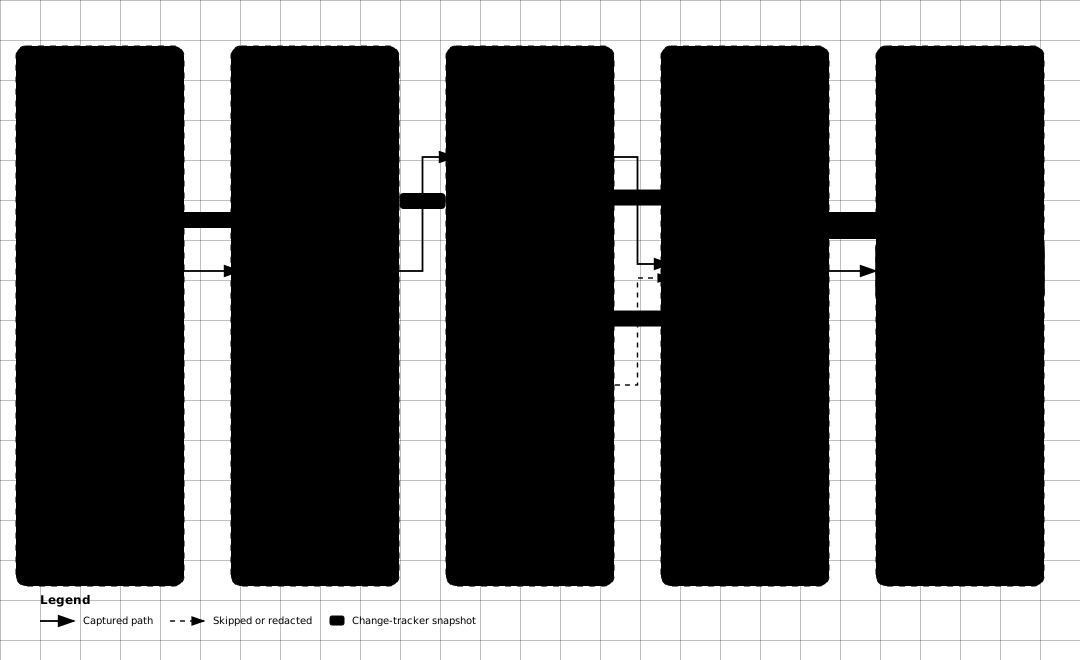
Two gates decide what ends up in the trail: an entity-level gate driven by AuditLogBehaviour, and a property-level
gate driven by AuditPropertyPolicy and the redactor:
- DKNet.EfCore.Abstractions supplies the contract: entities must implement
IAuditedProperties(directly, or via theAuditedEntity/AuditedEntity<TKey>base classes) to be eligible for auditing at all, and the[AuditLog]/[IgnoreAuditLog]/[SensitiveData]attributes that steer what gets captured live there, not in this package. - DKNet.EfCore.Hooks provides the
SaveChangespipeline.EfCoreAuditHookis a normalIHookAsynchook, registered with the sameAddHook<TDbContext, THook>()call any other hook uses, and only runs if theDbContextwas registered viaAddDbContextWithHook<TDbContext>(oroptions.UseHooks<TDbContext>(provider)manually) — auditing shares the exact same wiring requirement as domain events or data authorization hooks on the sameDbContext. - Because multiple hooks can be registered for one
DbContext, the audit hook runs alongside e.g. a domain-events hook or a data-authorization hook in the same before/after-save pass;HookRunnerInterceptorruns allBeforeSaveAsynchooks in DI registration order, then (after the underlyingSaveChangesAsyncsucceeds) allAfterSaveAsynchooks in DI registration order — there is no explicit priority system, so if audit ordering relative to another hook matters, control it via registration order.
⚠️ Gotchas & limits
- Registering the hook is not enough.
AddEfCoreAuditHook/AddEfCoreAuditLogsonly add DI registrations; withoutAddDbContextWithHook<TDbContext>(or a manualoptions.UseHooks<TDbContext>(provider)), theHookRunnerInterceptoris never attached to theDbContextand the audit hook silently never runs. - Only
IAuditedPropertiesentities are audited. A plain entity that doesn’t implement it (or inheritAuditedEntity/AuditedEntity<TKey>) is always skipped, regardless ofAuditLogBehaviour. - Redaction hides values, not the fact of a change. A redacted field still appears in
Changeswith bothOldValueandNewValueset to"***REDACTED***", so the entry tells you a sensitive field changed but never what it changed to — and it can no longer tell you whether the new value actually differs from the old one. - Creates carry no field diff.
Action == AuditLogAction.Createdentries always have an emptyChangeslist by design — if you need a full snapshot of a newly created entity, a publisher must fetch it separately usingKeys. - Publishing is awaited, not fire-and-forget.
AfterSaveAsyncawaits every registered publisher in turn, so a slow or blockingIAuditLogPublisheradds directly toSaveChangesAsynclatency for every save that produced audit entries. Keep publishers fast, or hand off to a background queue from inside your publisher. - Publisher exceptions are swallowed, not surfaced. A throwing
PublishAsyncis caught, optionally logged (if anILogger<EfCoreAuditHook>is configured, atErrorlevel — naming the publisher, the entity name(s), and the entry count, never the entries’ values), and does not fail the save — other registered publishers still run. This is an accepted trade-off, not a bug:PublishLogsAsyncruns fromAfterSaveAsync, after the write has already committed, so there is no recovery path for a dropped audit entry — a failure here cannot roll back the save, and by the time it happens the one chance to persist the audit entry atomically with the write is already gone. Retrying or queuing insideIAuditLogPublisherdoesn’t close that gap, since the entry it would retry was never durably recorded in the first place. If you need at-least-once delivery of audit logs, don’t rely on this hook for it — write the entries to an outbox table from aBeforeSaveHookAsyncinside the same save transaction as the entity write, and drain that table with a separate dispatcher. - Performance cost scales with tracked entities and properties per
SaveChangesAsynccall.BeforeSaveAsyncwalks every trackedAdded/Modified/Deletedentry and every one of its mapped scalar properties (with a reflection-based attribute check per property) on every save. Narrowing scope withAuditLogBehaviour.OnlyAttributedAuditedEntitiesand/orAuditPropertyPolicy.OnlyAttributedPropertiesreduces that cost for hot paths. - Navigation properties and collections are not diffed. Only the scalar/mapped properties on
entry.Propertiesare captured; related-entity changes are audited independently, on their ownAuditLogEntry, if the related entity itself implementsIAuditedProperties. ICurrentUserProvideris application-wide, and the first registration wins.AddCurrentUserProvider<TDbContext, TProvider>()registers the provider un-keyed behind anIsRegistered<ICurrentUserProvider>()guard, so a second call with a differentTProvidersilently keeps the first one — only the hook attachment to the newTDbContexttakes effect. There is no per-DbContextcurrent-user provider.- The current-user value is published unmasked. It is the audit identity, not an entity property, so no redaction rule applies to it. Return a stable non-personal identifier (a token subject id) if the audit trail is subject to a personal-data rule.
- No current user means no stamp from this package, not an error.
GetCurrentUser()returningnull/empty skips stamping silently; ifDKNet.EfCore.DataAuthorizationis also registered, its ownership key fillsCreatedBy/UpdatedByfor that save instead. A registration mistake therefore shows up as a tenant key inCreatedBy, or as blank audit fields — never as an exception. - Registering the same publisher type twice is a no-op.
AddEfCoreAuditLogs<TDbContext, TPublisher>returns early if a keyed registration for that exactTPublisherandDbContextkey already exists, so a second call (e.g. from two library extension methods) does not double-publish — but it also silently ignores any differentbehaviour/propertyPolicyyou passed on the second call.
🔗 Related packages
- DKNet.EfCore.Hooks – the
SaveChangespipeline this package registers into. Reach for it directly when you need a custom before/after-save hook of your own. - DKNet.EfCore.Abstractions – defines
IAuditedProperties,AuditedEntity<TKey>, and the[AuditLog]/[IgnoreAuditLog]/[SensitiveData]attributes. Reach for it to make an entity auditable in the first place. - DKNet.EfCore.Events – dispatches domain events through the same pipeline. Reach for it when other parts of the system must react to a change rather than record it.
- DKNet.EfCore.Encryption – column-level encryption. Reach for it to protect a value at rest; this package only decides whether the value appears in an audit entry.
- DKNet.EfCore.DataAuthorization – row-level ownership filtering on the same
hook pipeline. Reach for it to control who can see a row, not who changed it. It also supplies the ownership-key
fallback for
CreatedBy/UpdatedBywhen no current user is available for a save.